
The NSE IPO is official now. The National Stock Exchange has fixed the price band at ₹1,700–₹1,785 per share.
Subscription opens September 17, 2026, and runs through September 21. Anchor investors get their allocation a day before the public opening, on September 16, and if the current schedule holds, the stock lists around September 24, 2026.
This one’s a pure Offer for Sale — NSE itself isn’t issuing new shares, so none of the proceeds go to the exchange. It’s existing shareholders selling, and the number being sold has actually come down: about 12.64 crore shares now, versus the roughly 14.89 crore that earlier reports had floated.
Do the math at the top of the band, ₹1,785, and NSE is being valued at around ₹4.42 lakh crore. The total offer size comes to about ₹22,561 crore — which puts it firmly among the largest IPOs India has seen.
For retail investors, the minimum lot is 8 shares, so applying at the upper price band means putting up ₹14,280.
What’s changed with this pricing is really the clarity. Before, you were working off a much bigger hypothetical issue size and a valuation nobody could pin down. Now there’s an actual price range, fewer shares in the pool, and a much better sense of what you’d actually be paying for.
Last Updated: September 12, 2026
NSE IPO 2026: Key Details
| Particular | Details |
|---|---|
| IPO | NSE IPO 2026 |
| Price Band | ₹1,700–₹1,785 per share |
| IPO Open Date | September 17, 2026 |
| IPO Close Date | September 21, 2026 |
| Anchor Bidding | September 16, 2026 |
| Expected Listing | September 24, 2026 |
| Issue Type | Offer for Sale (OFS) |
| Shares Offered | About 12.64 crore |
| Issue Size | About ₹22,561 crore |
| Lot Size | 8 shares |
| Minimum Investment | ₹14,280 at the upper price band |
| Implied Valuation | About ₹4.42 lakh crore |
The NSE IPO is different from a typical fresh-issue IPO. Since the entire offering is an OFS, the money paid by investors will go to the shareholders selling their stakes rather than to NSE’s business.
The reduced number of shares being offered is also worth noting. The offer has been cut from the earlier proposal of around 14.89 crore shares to about 12.64 crore shares. At the upper price band, that puts the total offer value at roughly ₹22,561 crore.
For a retail investor, the calculation is straightforward: 8 shares at ₹1,785 each means ₹14,280 for one lot. Investors should remember that the lot amount is only the application value; actual allotment depends on the level of subscription.
The more important question is valuation. At roughly ₹4.42 lakh crore, NSE is entering the market at a very large valuation, so its future earnings, trading volumes and ability to diversify beyond options revenue will matter when investors assess the stock after listing.

NSE runs the Nifty 50 — India’s benchmark stock index — and it’s basically the backbone of Indian equity and derivatives trading.
Here’s what makes this IPO unusual: it’s a pure Offer for Sale. Existing shareholders are cashing out part of their stake, but NSE itself doesn’t see a rupee of the proceeds. The money goes straight to the sellers.
The scale is what’s got everyone talking. NSE could be valued at several lakh crore rupees, and if the ₹30,000 crore figure holds, this becomes India’s largest IPO ever.
It’s been a long road. NSE has wanted to list for years, but legal fights and regulatory delays kept pushing it back — until SEBI cleared it in September 2026.
From there:
- IPO Opens: September 17, 2026
- IPO Closes: September 21, 2026
- Allotment: ~September 22, 2026
- Shares Credited to Demat: ~September 23, 2026
- Listing Day: September 24, 2026
So roughly a week between opening and listing. Take all of this with a grain of salt until NSE actually publishes the final documents these things shift.
This IPO is getting a lot of buzz, and it’s not hard to see why — NSE basically sits at the center of Indian markets, and the numbers involved are huge.
But here’s the thing people gloss over: this isn’t a normal IPO. It’s a pure Offer for Sale. Existing shareholders are cashing out, not NSE. The company doesn’t see a single rupee of the money raised.
Owning a piece of NSE does mean owning a piece of something genuinely important — it’s core market infrastructure, not some random company riding a hype cycle. That said, “important” and “good investment” aren’t the same thing.
Before you put money in, actually look at the numbers: NSE’s financials, how tied its revenue is to trading volumes, the regulatory risks it faces, competition from other exchanges, and whether the valuation makes sense. And read the risk disclosures in the final offer documents — that’s usually where the real caveats show up, buried past the headline numbers.

NSE IPO Issue Size and Shares Offered
The proposed NSE IPO is expected to be one of the largest public offerings in India’s capital markets.
Investors should therefore treat the currently reported figures as indicative until the final IPO details are officially announced.
NSE is one of India’s biggest financial market institutions — most people know it for the Nifty 50 and equity trading, but that’s really just the headline. It runs electronic trading across equities, equity derivatives, currency derivatives, debt securities, and a handful of other products.
The tech behind it is what actually matters here. That infrastructure is how investors and institutions plug into Indian capital markets in the first place — without it, none of the rest works.
Then there’s the index business. Nifty 50 is the one everyone quotes, but it’s also the benchmark fund managers and institutions build strategies around.
All of this means NSE’s own financial performance rides on things outside its direct control: how much trading is happening, how many people are participating, transaction volumes, whether the tech holds up, and whatever regulators decide next.
NSE Financial Performance
NSE’s numbers point to a healthy, profitable business — though profit isn’t growing quite as fast as revenue is. Revenue from operations in Q1 FY2026–27 came in at ₹4,560.41 crore, up from ₹4,032.24 crore in the same quarter a year before — roughly 13.1% growth. Profit moved up too, from ₹2,923.85 crore to ₹3,120.08 crore, but that’s a slimmer 6.7% gain by comparison.
| Financial Metric | Q1 FY2026–27 | Q1 FY2025–26 | Change |
|---|---|---|---|
| Revenue from Operations | ₹4,560.41 crore | ₹4,032.24 crore | +13.1% |
| Profit for the Period | ₹3,120.08 crore | ₹2,923.85 crore | +6.7% |
What the Numbers Tell Investors
The numbers point to continued growth, but they also show why revenue growth should not be viewed in isolation.
Revenue increased by more than 13%, while profit grew by about 7%. That means investors should pay attention to margins and the factors that could affect NSE’s earnings as trading activity and regulations change.
NSE’s profitability is one of the stronger points of the IPO story. At the same time, the valuation being sought is substantial, so investors need to consider whether this level of earnings can continue to grow enough to support the IPO valuation over the long term.
For that reason, the financial results are more useful when viewed alongside NSE’s business model and the regulatory risks facing the exchange rather than as a standalone reason to invest.
For more market-focused coverage, explore the BizzTechDaily Markets section for the latest IPO and financial-market updates. You can also read our latest analysis of the Rentomojo IPO 2026 for another upcoming Indian market listing.
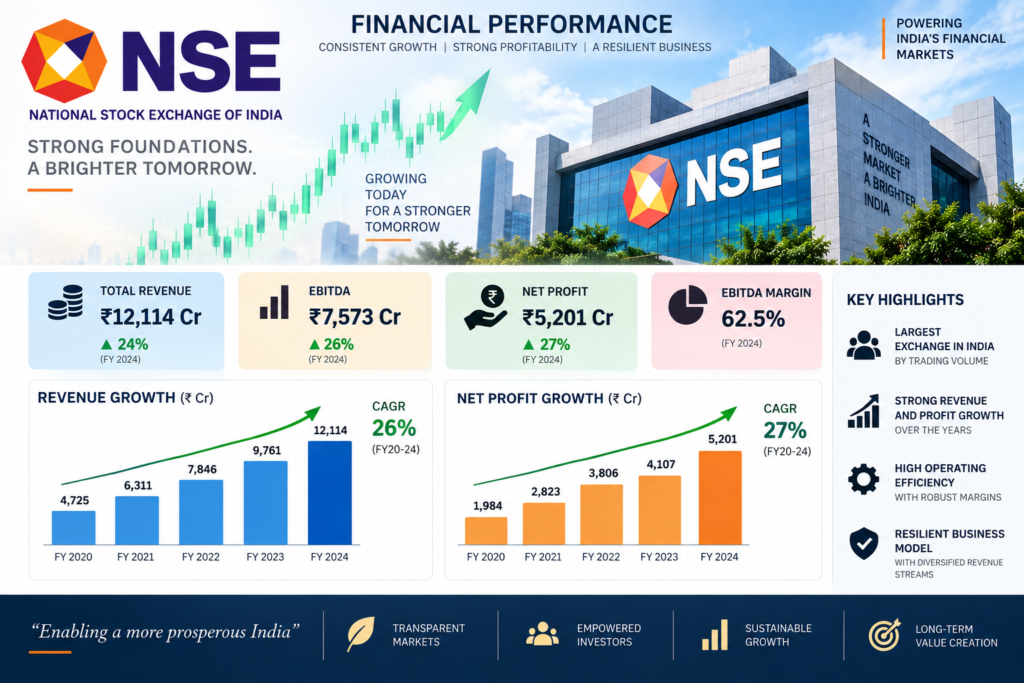
NSE Financial Snapshot
| Metric | Q1 FY2026–27 | Q1 FY2025–26 |
|---|---|---|
| Revenue from Operations | ₹4,560.41 crore | ₹4,032.24 crore |
| Profit for the Period | ₹3,120.08 crore | ₹2,923.85 crore |
NSE’s revenue from operations increased by approximately 13.1% year over year in the June 2026 quarter.
Profit for the period increased by approximately 6.7% compared with the same quarter of the previous year.
The figures above are from NSE’s audited consolidated financial results for the quarter ended June 30, 2026.
Why the NSE IPO Is Different
The NSE IPO stands out for a reason that has little to do with the size of the issue alone. Investors are getting an opportunity to own a stake in the company that operates one of India’s most important financial-market platforms.
Unlike a manufacturing or consumer company, NSE benefits from activity across the capital markets. Its business is closely connected to trading volumes, market participation and the products investors use on the exchange.
There is another important distinction: this IPO is entirely an OFS. NSE is not raising fresh capital for expansion or debt repayment. Existing shareholders are using the public issue to sell part of their holdings.
That means investors should look at the IPO differently from a fresh-share issue. The key question is not how NSE plans to deploy IPO money, because it isn’t receiving that money. Instead, the focus should be on the company’s existing business, earnings potential and the valuation at which the shares are being offered.
The IPO also comes at a time when India’s participation in the stock market has expanded significantly. That creates a potentially attractive long-term backdrop for market infrastructure businesses, although regulatory changes and shifts in trading behaviour remain important risks.
NSE IPO: Key Risks Investors Should Consider
NSE holds a strong position in India’s financial markets, but that doesn’t mean the business is risk-free — and given where the IPO is priced, these risks carry more weight than they might for a cheaper stock.
Regulatory changes
NSE operates under close regulatory oversight, and that’s not going to change. Any shift in rules around derivatives, trading charges, or market participation can flow straight through to the exchange’s revenue and profitability.
Reliance on trading volumes
A big chunk of NSE’s business tracks how much trading actually happens on the exchange. If participation cools off or volumes slow down, revenue growth is likely to slow right along with it.
Heavy derivatives exposure
Options and other derivatives have become a major driver of activity here. That’s good news while it lasts, but it also means any regulatory shift or change in trader behavior that pulls back derivatives volumes could hit future earnings harder than it would a more diversified business.
Valuation risk
At the top of the price band, ₹1,785, NSE comes out valued at around ₹4.42 lakh crore. That’s a big number — and it means investors are effectively paying up front for a lot of future growth, not just today’s earnings.
No fresh money for NSE
Worth remembering: this IPO is entirely an Offer for Sale, so none of the proceeds actually land with NSE. Don’t expect this listing to fund new projects, expansion, or debt reduction at the exchange — that’s simply not what an OFS does.
What to watch after listing
Once the stock is trading, the things worth tracking are revenue growth, profitability, trading activity, how regulation evolves, and — maybe most importantly — what valuation the market is actually willing to pay for the stock over time.

NSE IPO GMP: What Does Grey Market Premium Mean?
Grey market activity currently has the NSE IPO trading at a premium of around ₹190 per share, based on the latest unofficial indications floating around. Add that to the ₹1,785 upper price band, and you get an indicative price near ₹1,975 — which works out to roughly 10.6% above the top of the IPO range.
| NSE IPO GMP Indicator | Latest Indication |
|---|---|
| IPO Upper Price Band | ₹1,785 |
| GMP | Around ₹190 |
| Indicative Price | Around ₹1,975 |
| Indicative Premium | Around 10.6% |
How to Read the NSE IPO GMP
GMP, or Grey Market Premium, is not an official NSE or SEBI figure. It reflects activity in the unofficial market before listing and can move considerably based on demand, market conditions and investor sentiment.
For that reason, a ₹190 GMP should not be treated as a guaranteed listing gain. The actual listing price can be higher or lower.
For investors tracking the NSE IPO, the GMP is useful as a sentiment indicator, but it should be considered alongside the IPO valuation, NSE’s financial performance, trading volumes and the risks discussed below.
GMP Last Updated: September 12, 2026
Disclaimer: Grey Market Premium figures are unofficial, can change frequently and should not be considered a prediction or guarantee of the listing price.
Should You Apply for the NSE IPO?
There’s no clean yes-or-no here. NSE has a genuinely strong position in India’s capital markets and a large, established business behind it — but the valuation doesn’t leave much room for things to go wrong.
Why investors might find it attractive
NSE sits at the center of India’s financial-market infrastructure, with a dominant position across several key segments — that’s not something many companies can claim. The numbers back it up too: profit for the period came to ₹3,120.08 crore in Q1 FY2026–27, up from ₹2,923.85 crore in the same quarter a year earlier. And looking further out, rising participation in equities, derivatives, and other financial products could keep working in NSE’s favor over the long run.
Where investors should be more cautious
The valuation is the big one. At the upper price band, NSE is being priced at roughly ₹4.42 lakh crore — which raises the obvious question of whether future earnings growth can actually justify that number. There’s also the fact that a large chunk of NSE’s revenue comes from trading activity, especially in derivatives, so any shift in trading patterns or regulation could feed straight into earnings. Speaking of regulation — exchanges operate under close oversight, and changes to rules around derivatives, transaction charges, or market participation can hit the business directly. One more thing worth remembering: since this is entirely an Offer for Sale, none of the IPO money actually goes to NSE. It all goes to the shareholders selling their stake.
Bottom line
If you’re looking for exposure to India’s growing financial markets and you’re comfortable holding for the long haul, NSE could make sense. But don’t judge this one off the brand name or the grey market premium alone — the ₹1,700–₹1,785 price band, and the valuation that comes with it, matter just as much. Weigh that valuation against NSE’s earnings, growth outlook, and regulatory risk before deciding.
NSE IPO 2026: Final Takeaway
The NSE IPO isn’t speculation anymore — the price band, issue size, and subscription dates are all locked in now. And there’s a real case for paying attention: the exchange holds a strong position in India’s capital markets and has the profitability to back it up.
But none of that changes the math on valuation. At the upper band, NSE works out to around ₹4.42 lakh crore — enough that reputation alone shouldn’t be the deciding factor for anyone applying.
The OFS structure is worth sitting with too. Since NSE isn’t raising any fresh capital here, this IPO is really about existing shareholders cashing out and new investors getting a seat at the table — not about funding anything new at the exchange itself.
As for the grey market premium — sure, it’ll grab short-term attention, but it moves fast and it doesn’t actually decide where the stock lists. A better use of time is looking past the GMP altogether: what you’re actually paying, how NSE is earning, where growth might come from, how much trading activity is flowing through the exchange, and what the regulatory environment looks like going forward.
Once September 17 rolls around and subscription opens, the bidding data and overall market mood should give a clearer read on how much demand there really is. We’ll keep updating this as more official information comes in.