
The Veegaland Developers IPO 2026 is not just another real estate IPO where the main story is the issue size and grey market premium.
The more interesting question is whether Veegaland can convert the projects it has already sold and the development pipeline it has built into consistent earnings over the next few years.
The company is raising ₹210 crore through a fresh issue at ₹130–₹140 per share. The IPO opened on September 10 and will close on September 15, 2026. The current schedule places allotment on September 16 and listing on September 18 on NSE and BSE.
There is already some interest in the issue. On Day 1, the IPO received bids for around 70.26 lakh shares against 1.13 crore shares available in the public portion, taking overall subscription to about 0.62 times. Retail investors were ahead of the other categories at that point.
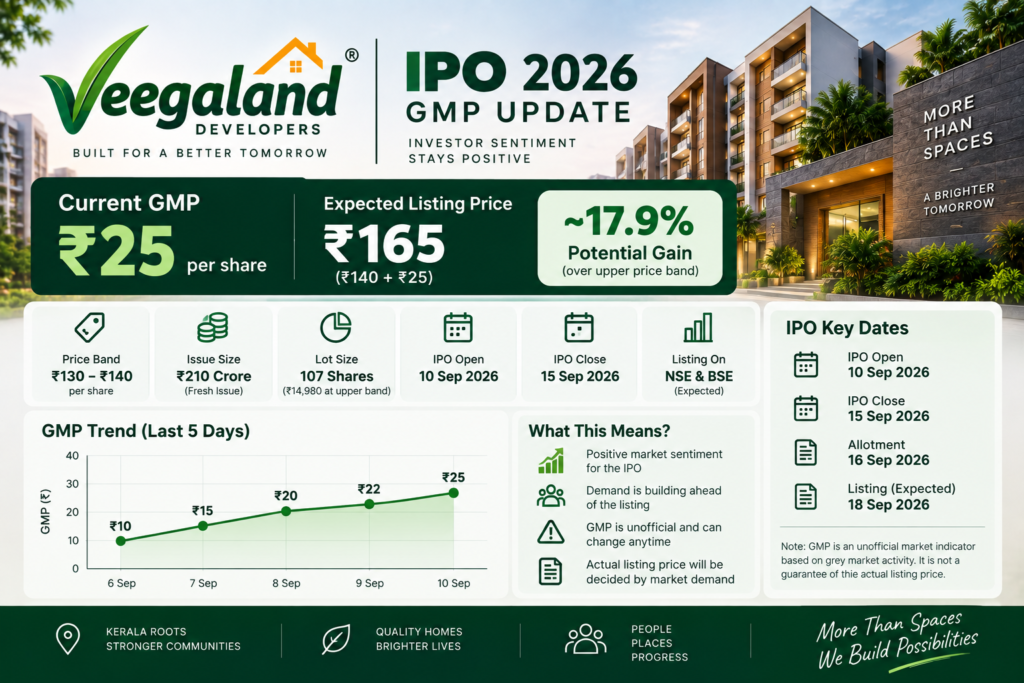
The grey market is also indicating a premium of around ₹25 as of the latest September 10 update. But that number is unofficial and can change quickly, so it is much more useful as a sentiment indicator than as a prediction of the eventual listing price.
What makes the company worth studying is elsewhere: 25 residential projects, a substantial ongoing pipeline, strong sales absorption in completed developments and a sharp improvement in profitability over the last three financial years.
This article looks at those numbers and asks what they actually mean for an investor.
Veegaland Developers IPO 2026: Key Details
| Particular | Details |
|---|---|
| Company | Veegaland Developers Limited |
| IPO | Veegaland Developers IPO 2026 |
| Issue Type | Fresh Issue |
| Issue Size | ₹210 crore |
| Price Band | ₹130–₹140 |
| Face Value | ₹10 |
| IPO Open Date | September 10, 2026 |
| IPO Close Date | September 15, 2026 |
| Lot Size | 107 shares |
| Minimum Investment | ₹14,980 |
| Allotment | September 16, 2026 |
| Expected Listing | September 18, 2026 |
| Listing Exchanges | NSE & BSE |
| Registrar | MUFG Intime India |
| Lead Manager | Cumulative Capital |
| Current GMP | Around ₹25* |
*GMP is unofficial and can change at any time. The figure above reflects the latest market update available at the time of writing.
At the upper price of ₹140, one retail lot of 107 shares requires ₹14,980.
The First Thing to Understand: Veegaland Is Selling a Pipeline, Not Just a Story
Real estate businesses can sometimes look attractive because revenue and profit jump sharply when projects move through different stages.
That makes one-year financial growth less useful on its own.
For Veegaland, the more interesting data point is the size and status of its development pipeline.
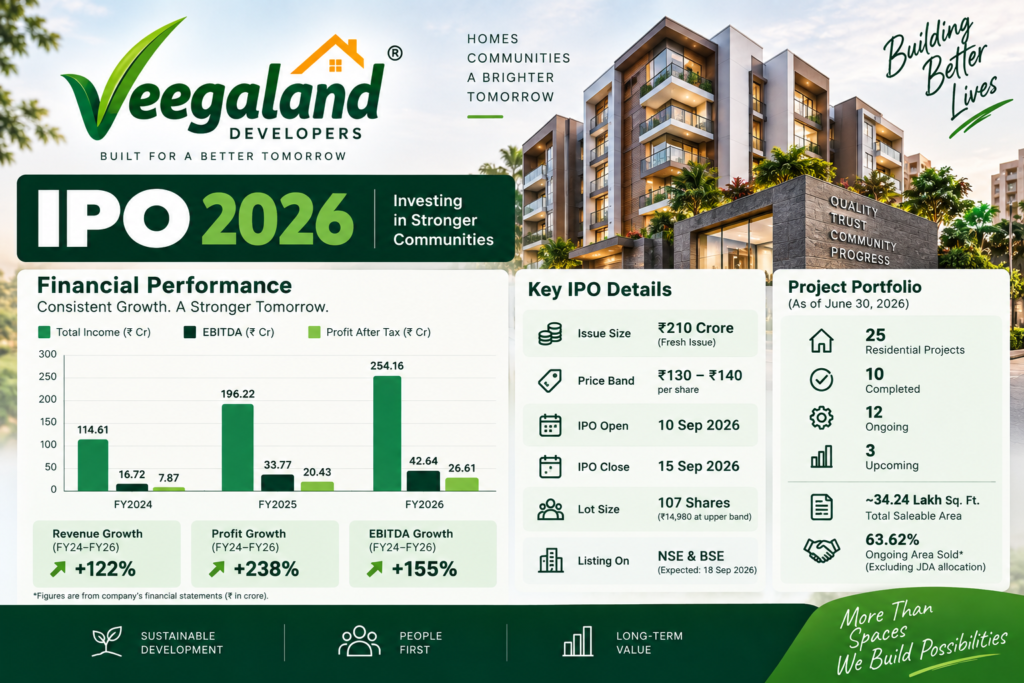
As of June 30, 2026, the company had 25 residential projects covering approximately 34.24 lakh square feet of saleable area.
Those projects consisted of:
- 10 completed projects
- 12 ongoing projects
- 3 upcoming projects
The completed projects covered about 11.05 lakh sq. ft., while ongoing projects accounted for another 18.57 lakh sq. ft.
And there is an important detail hidden inside that number.
The company says all of its completed projects had been sold as of June 30, 2026. In its ongoing portfolio, around 63.62% of the saleable area had already been sold, excluding the area allocated to landowners under joint development arrangements.
That gives us something more useful than simply saying “the company has a strong project pipeline.”
It tells us that a meaningful portion of its current development inventory has already found buyers.

What Does Veegaland Actually Do?
Veegaland Developers is a Kerala-focused real estate developer whose portfolio is primarily residential.
Its projects are spread across locations including Kochi, Thiruvananthapuram, Kozhikode and Thrissur, giving the company exposure to several important urban markets within Kerala.
The company uses a combination of land acquisition and joint development arrangements.
That matters because real estate growth is not only about constructing buildings. The cost and availability of land can determine how quickly a developer can expand.
A joint development model can allow a developer to participate in projects without purchasing the entire land parcel outright, although it also means the economics of individual projects can differ depending on the agreement with the landowner.
Veegaland’s development model therefore depends on three things working together:
finding suitable projects → executing them → selling enough inventory at profitable prices.
That sounds simple, but this is exactly where real estate businesses can succeed or fail.
The Project Pipeline Is Probably the Most Important Part of This IPO
Here is where the Veegaland story becomes more interesting.
The company had 12 ongoing projects as of June 30, 2026, covering around 18.57 lakh sq. ft. of saleable area.
Of that ongoing portfolio, approximately 63.62% of the saleable area had already been sold, excluding JDA allocations.
The company had also sold 637 units across the ongoing projects, according to data based on its offer documents.
That creates a useful distinction:
Veegaland is not entering the IPO with an entirely unbuilt future pipeline. A significant portion of its ongoing inventory has already been booked.
That doesn’t eliminate execution risk. Construction still has to be completed, customers have to complete payments, costs have to remain under control and projects have to be delivered.
But it does provide a degree of visibility that a developer with only undeveloped land would not have.
₹909 Crore of Contracted Sales: Why This Number Matters
One of the more useful figures to look at is Veegaland’s reported contracted order book of around ₹909.4 crore as of June 30, 2026. This is based on sale agreements for its ongoing projects.
That number should not be confused with revenue or profit.
A contracted order book does not mean Veegaland will immediately receive ₹909 crore in cash or recognise ₹909 crore as revenue.
Revenue recognition depends on project completion, accounting rules, customer payments and other conditions.
But the figure does give investors a sense of the amount of business already contracted within the ongoing portfolio.
For a developer, that can be more informative than looking at the IPO size alone.
The IPO is raising ₹210 crore.
Against that, the company has reported around ₹909.4 crore of contracted sales from ongoing projects.
Those two numbers are not directly comparable, but the contrast is useful: the IPO is relatively small compared with the sales value already attached to the current project pipeline.
The real question is how much of that contracted business ultimately converts into revenue and profit.
Veegaland’s Financial Growth: Good, But Look Beyond the Headline
Veegaland’s financial numbers have improved considerably over the last three years.
| Financial Year | Total Income | EBITDA | Profit After Tax |
|---|---|---|---|
| FY2024 | ₹114.61 Cr | ₹16.72 Cr | ₹7.87 Cr |
| FY2025 | ₹196.22 Cr | ₹33.77 Cr | ₹20.43 Cr |
| FY2026 | ₹254.16 Cr | ₹42.64 Cr | ₹26.61 Cr |
Revenue is the obvious headline here. Total income went from ₹114.61 crore in FY2024 to ₹254.16 crore in FY2026 — more than double in just two years. Profit followed the same direction, climbing from ₹7.87 crore to ₹26.61 crore over that stretch.
What’s more telling, though, is the pace: profit actually grew faster than revenue did. Zoom in on just FY2025 to FY2026, and total income moved from ₹196.22 crore to ₹254.16 crore, while PAT jumped from ₹20.43 crore to ₹26.61 crore — a bigger percentage gain than the revenue line saw. EBITDA tells a similar story, rising from ₹33.77 crore to ₹42.64 crore in the same year.
Put together, this points to something beyond just “selling more homes.” Operating profitability seems to be improving in its own right, not just riding on top-line growth. That said, it’s worth being careful about assuming this pace continues — real estate revenue tends to be lumpy, since project completions and sales recognition don’t land evenly across periods.
One Number Investors Should Watch: Sales Conversion
Veegaland’s project pipeline looks strong on paper, but the real test is conversion.
Think about the business in three stages:
Project launched → homes sold → project delivered and revenue recognised
The company has already demonstrated strong sales absorption in completed projects, with all 10 completed projects reported as fully sold.
The next question is whether it can reproduce that performance across its larger ongoing portfolio.
The 63.62% sales figure is therefore worth watching.
If that percentage continues increasing while construction progresses, it could support future revenue visibility.
If sales slow significantly, however, the company could face a very different situation: more capital tied up in inventory and greater dependence on external funding or collections.
That is one of the reasons we shouldn’t judge the IPO simply from the current GMP.
What Will Veegaland Do With the IPO Money?
The company plans to use approximately ₹119.83 crore of the IPO proceeds toward expenses related to the development of its ongoing and upcoming projects.
The remaining proceeds are intended for unidentified land acquisition and general corporate purposes.
This is an important part of the IPO.
The company is not primarily raising money so that existing shareholders can sell their stake.
Instead, the issue is a fresh issue, meaning new capital is coming into the company.
That creates a straightforward question for investors:
Can ₹119.83 crore of additional capital help Veegaland expand its development activity and generate returns greater than the cost of that capital?
If yes, the fresh issue can become a genuine growth driver.
If the money simply gets absorbed into projects without generating attractive returns, the IPO becomes less compelling.
Veegaland IPO Valuation: The Price Matters More Than the GMP
At the upper price band of ₹140, third-party calculations based on the offer-document figures put the post-issue P/E at around 25.64×. The same data puts the post-issue P/BV at around 1.77×.
That isn’t automatically cheap or expensive.
It depends on what earnings investors believe Veegaland can generate after the IPO.
This is particularly important because the fresh issue will increase the company’s share count.
Based on the reported FY2026 EPS of about ₹7.89 before the issue, the ₹140 upper band represents a relatively substantial multiple of current earnings.
But the company is also bringing fresh capital into the business.
So investors are effectively paying for:
- The existing business.
- The current project pipeline.
- The future projects the IPO capital may help create.
- The expectation that profitability can continue improving.
That’s why simply comparing ₹140 with the current EPS doesn’t tell the entire story.
The valuation only makes sense if future earnings can grow enough to justify it.
GMP Looks Positive. But Here’s Why We Shouldn’t Get Too Excited
The latest reported GMP is around ₹25.
At the ₹140 upper price band, that would imply an unofficial grey-market indication around ₹165.
That represents roughly an 18% premium to the issue price.
But there is an important catch.
GMP is not the stock exchange.
It is not a company announcement.
It is not guaranteed listing value.
And it can change before the IPO closes.
Financial Express reported the ₹25 GMP figure on September 10 and specifically noted that grey-market premiums fluctuate and are not an official measure of listing price.
So the useful way to interpret the GMP is:
Investors currently appear willing to pay a premium for the shares in the unofficial market.
That’s interesting.
But the more important question for a long-term investor is:
Would you still want the company if the GMP were ₹0?
If the answer is no, then the investment thesis may be driven more by listing expectations than by the business.
Veegaland Developers IPO Risks Investors Should Not Ignore
1. Real Estate Is an Execution Business
A developer can have a large project pipeline and still disappoint investors if projects are delayed or costs rise.
Construction timelines, approvals, labour availability and material prices can all affect returns.
2. Sales Can Slow
The current sales numbers are encouraging, but the housing market is cyclical.
If demand weakens, inventory may take longer to sell.
That can lock up capital and affect cash flows.
3. Construction Costs Matter
A developer’s selling price may look attractive, but margins can fall if construction and development costs rise faster than expected.
This is particularly important for projects that take several years to complete.
4. Concentration in Kerala
Veegaland has established itself primarily in Kerala.
That provides local market knowledge and a focused operating strategy.
But it also means the company does not have the geographical diversification of large national developers.
5. IPO Valuation
The biggest risk may simply be paying too much.
A company can have good projects, rising revenue and improving profits and still deliver poor shareholder returns if investors enter at an excessive valuation.
That’s why the ₹130–₹140 price band deserves as much attention as the GMP.
What I Think Investors Should Actually Watch
Rather than trying to predict the listing price, there are five numbers I’d watch after the IPO.
1. Sales of ongoing projects
The current 63.62% sold figure gives us a baseline.
Does that continue moving higher?
2. Revenue growth
Can Veegaland maintain growth once the current project cycle changes?
3. Profit margins
Revenue growth without improving profitability wouldn’t be enough.
4. Cash generation
Accounting profit and actual cash generation aren’t always the same thing in real estate.
5. Return on the new IPO capital
This is probably the most important long-term question.
If ₹119.83 crore is invested successfully into projects, what additional earnings does that capital eventually produce?
That’s something investors will only be able to judge over time.
You can also compare this with our analysis of the Hero Motors IPO 2026, where we look at how IPO capital, earnings growth and valuation affect the investment case.
Veegaland Developers IPO 2026: Should You Apply?
There isn’t a one-line answer.
The positive case is fairly straightforward.
Veegaland has grown its revenue and profit strongly over the last three financial years. It has completed projects that were fully sold, a sizeable ongoing project pipeline and a meaningful amount of contracted sales. The IPO is also a fresh issue, so capital is coming into the business rather than being used primarily for an exit.
The less comfortable side of the story is valuation and execution.
At ₹140, investors are not buying the company at a distressed valuation. They are paying for future growth.
That means the company has to execute.
If projects are delivered on time, sales continue and the new capital generates attractive returns, the current valuation can become easier to justify.
If growth slows, however, the valuation could become much harder to defend.
So for a long-term investor, I’d put project execution and future earnings ahead of the current GMP.
For a short-term listing-gain investor, GMP and subscription trends may matter more—but those are also the least reliable indicators of long-term value.
For another perspective on India’s upcoming IPO market, read our analysis of the NSE IPO 2026.
This is analysis for informational and educational purposes, not investment advice.
Veegaland Developers IPO Allotment and Listing
Here’s where things stand on timing: the IPO closes on September 15, 2026, with the basis of allotment finalized the next day, September 16. Refunds and share credits should follow on September 17, and if the schedule holds, the stock lists on September 18, 2026 — on both NSE and BSE.
That said, IPO timelines shift more often than people expect, so it’s worth double-checking with the exchange or the registrar closer to the date rather than treating this schedule as locked in.
Veegaland Developers IPO: Frequently Asked Questions
What’s the price band?
₹130 to ₹140 per share.
How much is the company raising?
Around ₹210 crore, entirely through a fresh issue.
What’s the lot size?
107 shares per lot. At the top of the band (₹140), that’s ₹14,980 for one lot.
What’s the GMP looking like today?
Around ₹25 as of the latest reporting — but treat that as a rough, unofficial signal, since GMP moves fast and can change by the day.
When does the IPO close?
September 15, 2026.
When’s allotment?
Currently scheduled for September 16, 2026.
When do shares list?
September 18, 2026 is the current target, with the stock listing on both NSE and BSE.
Fresh issue or OFS?
Fresh issue — this is entirely new capital going into the company, not existing shareholders selling down.
What will the money actually be used for?
The bulk of it, about ₹119.83 crore, is going toward development expenses for projects already underway or coming up next. The rest is earmarked for land acquisition (not yet identified) and general corporate purposes.
Is it worth applying for?
Depends on you, really — your time horizon, risk tolerance, and how you read the valuation. The project pipeline and growth numbers work in the company’s favor, but there’s real execution risk here, and the valuation at the top of the band isn’t necessarily cheap. Worth weighing both sides rather than just going off the growth story.
Veegaland Developers IPO 2026: BizzTechDaily Takeaway
The most interesting thing about Veegaland Developers isn’t the ₹25 GMP.
It’s the combination of project sales, pipeline and profitability.
The company has completed 10 projects, has 12 ongoing developments and three upcoming projects. More importantly, its completed projects had been fully sold and a substantial portion of the ongoing inventory had already been booked by customers as of June 30, 2026.
At the same time, the company’s financial performance has improved sharply, with total income rising from ₹114.61 crore in FY2024 to ₹254.16 crore in FY2026 and PAT increasing from ₹7.87 crore to ₹26.61 crore.
That gives Veegaland a credible growth story.
But the IPO isn’t being offered at a price where investors can ignore execution.
At ₹140, the company needs to keep growing for the valuation to make sense.
Our view: the strongest reason to study Veegaland is its combination of an already-sold completed portfolio, a partially sold ongoing pipeline and improving profitability. The biggest question is whether management can convert that pipeline into sustainable earnings while generating attractive returns from the new IPO capital.
That’s the part worth watching after the listing—not whether the grey market was right for one day.
This article is for informational and educational purposes only and should not be considered investment advice.
Official & Key Sources
- Veegaland Developers — Official IPO Documents
- SEBI — Veegaland Developers RHP
- Veegaland Developers — Investor Relations
- Financial Express — Veegaland Developers IPO Day 1 subscription and GMP update
- Economic Times — Veegaland Developers IPO and financial information