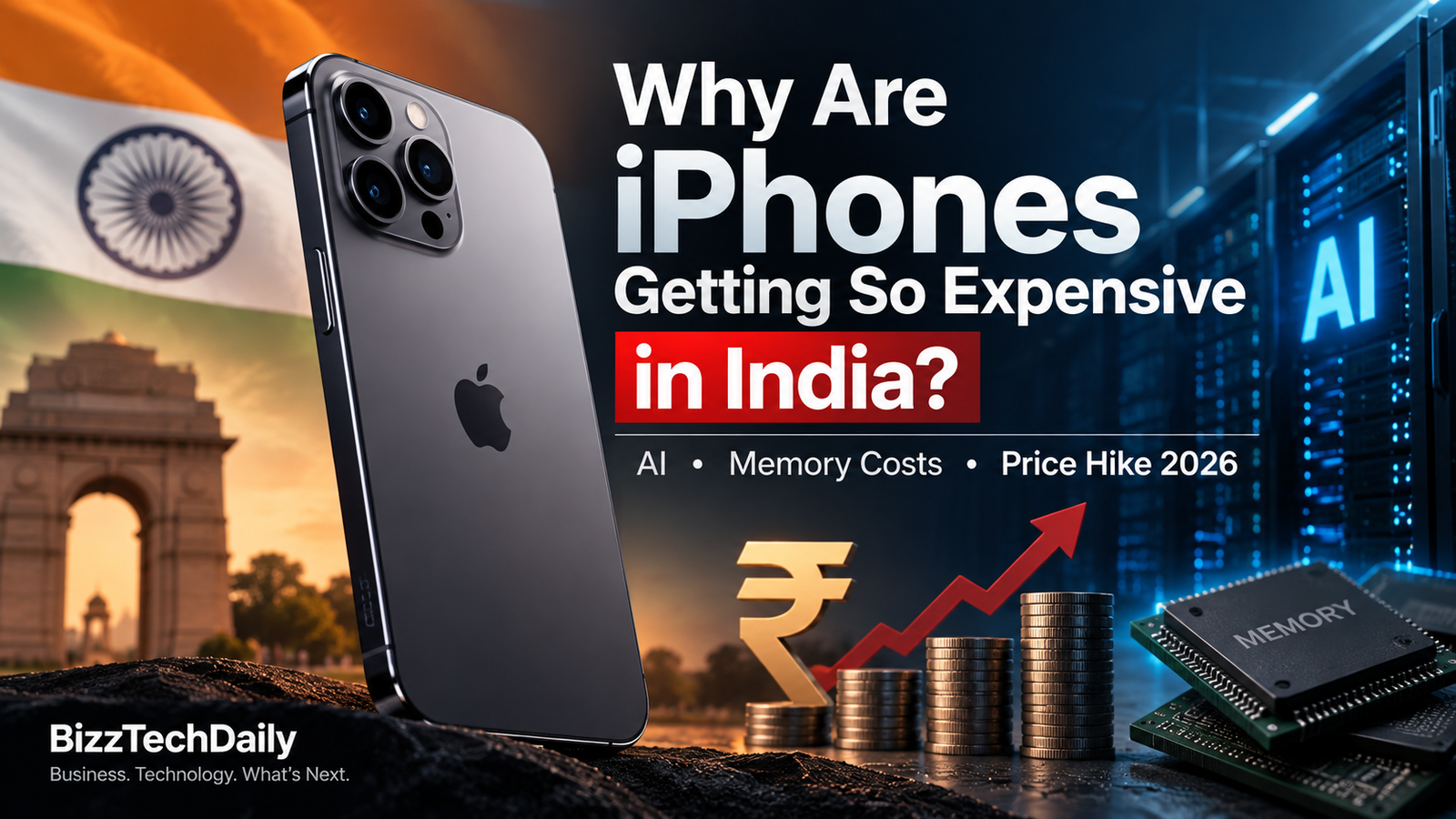
The iPhone price hike in India 2026 is making Apple’s latest smartphones significantly more expensive for Indian consumers. Apple has raised prices across parts of its iPhone lineup even as newer models enter the market, putting more pressure on Indian consumers who were already paying some of the world’s highest prices for premium smartphones.
The bigger story, however, is happening deeper inside the technology supply chain. The global AI boom is driving enormous demand for advanced chips and memory, increasing pressure on component supplies that are also used in smartphones. As AI infrastructure expands, the cost of building consumer devices could increasingly be affected.
That raises a bigger question: Is the iPhone becoming a luxury product in India, and could AI make smartphones even more expensive in the years ahead?
In this guide, we look at why iPhone prices are rising, what AI has to do with the increase, why India is particularly affected, and which iPhone makes the most sense to buy in 2026 based on your budget and needs.
Last Updated: September 12, 2026
Quick Take: Apple’s latest pricing changes highlight a broader shift in the smartphone industry: the AI boom is increasing demand for computing infrastructure and memory, potentially putting pressure on the components used in consumer electronics.
iPhone Prices in India: What Changed?
Apple’s iPhone lineup in India now covers a much wider price range than you’d typically expect from a premium smartphone brand. On one end, there’s the relatively affordable iPhone 17e; on the other, there’s the ultra-premium iPhone Air and Apple’s first-ever foldable iPhone.
The gap between those ends is genuinely large. Apple’s India store has the iPhone 17 starting at ₹99,900, with the iPhone 17e coming in lower at ₹79,900. Then there’s the iPhone Air, which starts at ₹1,49,900 — pushing Apple’s mainstream premium lineup well past the ₹1 lakh mark.
| iPhone | Starting price in India |
|---|---|
| iPhone 17e | ₹79,900 |
| iPhone 17 | ₹99,900 |
| iPhone Air | ₹1,49,900 |
| iPhone 18 Pro | ₹1,64,900 |
| iPhone 18 Pro Max | ₹1,79,900 |
| iPhone Duo | ₹2,99,900 |
Why Are iPhones Getting More Expensive in India?
There’s no single reason behind Apple’s latest price hikes. It’s really a combination of things: rising component costs — memory and storage especially — layered on top of Apple’s own pricing strategy and India’s tax and import structure.
Timing plays a big role here too. The AI boom has sent demand for memory chips through the roof, since AI servers eat up enormous amounts of it — and smartphone makers are now competing for the same semiconductor supply that AI companies are chasing. Counterpoint Research points out that smartphone memory prices climbed sharply through 2026, to the point where memory has become one of the single biggest line items in a smartphone’s bill of materials.
Apple has clearly passed some of that cost on to buyers. According to Reuters, the 2026 price increases hit India particularly hard, with some models jumping as much as 41%. The base-storage iPhone 17, for instance, now starts at ₹99,900, while the 1TB iPhone Air has climbed all the way to ₹2,24,900.
On top of the global cost pressures, there’s a purely local factor too: import duties plus an 18% GST both add to what you pay at checkout — even as India has grown into one of Apple’s more important manufacturing and export hubs for the iPhone.
1. Memory Chips Have Become a Major Cost Problem
One of the less visible reasons behind higher smartphone prices is the cost of memory.
Modern iPhones rely on memory and storage components for everything from running applications to storing photos, videos and AI-related workloads. As demand for AI infrastructure has surged, semiconductor manufacturers have increasingly prioritised higher-value memory products and data-centre demand.
That has pushed up costs across the memory market. Counterpoint Research reported that smartphone memory prices increased by more than 80% quarter over quarter in Q2 2026, while memory had become the most expensive single component in some smartphone bill-of-materials calculations.
This is where the iPhone story connects to the AI boom.
When companies build enormous AI data centres, they need huge quantities of advanced processors and high-performance memory. That demand puts pressure on semiconductor manufacturing capacity and can raise the cost of memory products across the industry.
The result is an unusual chain reaction:
AI data centres → higher memory demand → tighter memory supply → higher component costs → more expensive smartphones → higher prices for consumers.
In other words, the AI boom isn’t only changing the technology inside your phone. It can also change how much the phone itself costs.
2. Why India Is Seeing Such a Big iPhone Price Increase
That’s where we’ll cover GST, import duties, local manufacturing, currency and Apple’s India pricing, and compare India’s pricing with other markets.
India seems to be feeling Apple’s latest price hikes more than most markets. Prices went up across both new and existing iPhone models, right around the launch of the iPhone 18 Pro series and Apple’s first foldable, the iPhone Duo. Reuters put India among the hardest-hit markets globally, with some configurations seeing increases as steep as 41%.
Take the 256GB iPhone 17: it went from ₹82,900 to ₹99,900. The 1TB iPhone Air moved even more, from ₹1,59,900 up to ₹2,24,900. As for the new lineup, the iPhone 18 Pro starts at ₹1,64,900 in India, and the Pro Max starts a notch higher at ₹1,79,900.
Why India specifically? No single answer really covers it — it’s some mix of component costs, import duties, taxes, currency swings, and Apple’s own pricing calls all pulling in the same direction.
3. Taxes and Import Costs Add to the Final Price
One reason iPhones cost more in India is the tax and import structure surrounding smartphones and their components. Apple has significantly expanded iPhone manufacturing in India, but the country still relies on imported components and parts of the global supply chain.
In addition, smartphones sold in India are subject to an 18% Goods and Services Tax (GST). Import duties on components can also add to Apple’s cost structure. Reuters noted that these factors continue to push Indian iPhone prices above comparable US prices even as India becomes an increasingly important iPhone manufacturing hub.
This is important because manufacturing an iPhone in India does not mean every component inside it is manufactured in India. A modern smartphone is built from a global supply chain involving displays, memory, processors, cameras, batteries and numerous other components.
4. The Rupee and Global Costs Matter Too
Apple’s India pricing is also affected by the economics of selling a global product in a market where the currency can move significantly against the US dollar. When global component costs rise and the rupee weakens, maintaining the same local price can put pressure on Apple’s margins.
Recent analysis has pointed to rising memory costs, currency pressure and import-related expenses as factors behind the latest iPhone price increases in India.
That helps explain why the same iPhone can have a very different price tag in India and the US. US prices are generally quoted before local sales taxes, while India’s consumer-facing price already reflects applicable taxes and the economics of bringing the product to the Indian market.

India vs US: Why the Same iPhone Doesn’t Cost the Same
The difference becomes especially striking with Apple’s newest devices. The iPhone Duo starts at ₹2,99,900 in India, compared with $1,999 in the US before applicable sales taxes. The iPhone 18 Pro starts at ₹1,64,900 in India versus $1,199 in the US.
That doesn’t mean the entire difference is simply “Apple charging Indians more.” Taxes, duties, exchange rates, distribution costs and different tax-inclusive pricing systems all contribute. However, the size of the gap has renewed the debate over whether Apple’s premium pricing is pushing the iPhone further into luxury territory in India.
The interesting part is that India is simultaneously becoming one of Apple’s most important manufacturing hubs and one of its most expensive consumer markets.
That creates a paradox: more iPhones are being assembled in India, but Indian consumers aren’t necessarily seeing lower retail prices. Manufacturing localisation can strengthen Apple’s supply chain and export business without automatically eliminating the taxes, imported components, global component costs and pricing decisions that determine the final price consumers pay.
Which iPhone Should You Buy in 2026?
Prices have climbed enough this year that picking the right iPhone matters more than just grabbing whatever’s newest. Apple’s lineup now stretches from the value-focused iPhone 17e all the way to the premium iPhone 18 Pro models and the new foldable, the iPhone Duo — so there’s actually a real decision to make here, not just a default choice.
What’s right for you really comes down to budget, how much you care about camera quality, battery life expectations, and honestly, whether you even need the newest features or not.
1. iPhone 17e — Best for Value
Starts at ₹79,900
If the goal is getting into the iPhone ecosystem without crossing ₹1 lakh, this is the obvious pick. You’re getting Apple’s A19 chip, a 48MP Fusion camera, 256GB of storage to start, MagSafe, USB-C, and Apple Intelligence — plus Apple’s claimed 26 hours of video playback.
It makes the most sense for students, first-time iPhone buyers, or anyone who wants solid day-to-day performance without paying extra for Pro camera features they may not use.
BizzTechDaily verdict: the best budget iPhone of 2026.
2. iPhone 17 — Best Overall Choice
Starts at ₹99,900
For most people, this is the sweet spot — the best mix of price, performance, and features Apple currently offers. You get a 6.3-inch display with ProMotion, the same A19 chip, a 48MP Dual Fusion camera system, Camera Control, and up to 30 hours of video playback.
What matters here is that you’re getting most of what people actually notice day-to-day — smooth scrolling, a solid camera, good battery life — without crossing into ₹1.5 lakh-plus territory.
It’s a strong fit for everyday users, professionals, students, heavy content consumers, or really anyone who plans to hold onto their phone for a few years rather than upgrade annually.
BizzTechDaily verdict: the best iPhone for most people.
3. iPhone Air — Best for Thin and Lightweight Design
Starts at ₹1,49,900
This one’s for buyers who want a genuinely thin, lightweight premium design without giving up Pro-level performance. It packs a 6.5-inch ProMotion display, the A19 Pro chip, a 48MP Fusion camera, Camera Control, and up to 27 hours of video playback.
That said, at ₹1.5 lakh, it costs noticeably more than the standard iPhone 17 — so you’re really paying for the design and the feel of the thing, not for extra value on paper.
Best suited to buyers who care more about thinness and portability than squeezing out maximum value.
BizzTechDaily verdict: worth it if design matters more to you than the price tag.
4. iPhone 18 Pro — Best for Cameras and Performance
Starts at ₹1,64,900
This is where Apple firmly steps into flagship territory. You get the A20 Pro chip, a 48MP Pro Fusion camera system, variable aperture on the main sensor, 48MP Ultra Wide and Telephoto cameras, Pro-level camera controls, and an 18MP Center Stage front camera.
It’s an easy recommendation for photographers, videographers, and creators who want top-tier performance without stretching all the way to the Pro Max.
BizzTechDaily verdict: the pick for anyone serious about camera quality and performance.
5. iPhone 18 Pro Max — Best for Battery and Big-Screen Users
This is the one for people who want the biggest screen and the longest battery life, full stop. Apple rates it for up to 43 hours of video playback in India, and between the A20 Pro chip and its camera system, it’s arguably the most capable iPhone Apple makes right now.
The trade-off is straightforward — you’re paying a real premium for that size, battery, and flagship polish.
Makes the most sense for heavy users, gamers, frequent travelers, and creators who genuinely need every bit of that battery life.
BizzTechDaily verdict: the iPhone to get if price isn’t the main concern.
6. iPhone Duo — Best for the Newest Foldable Experience
Starts at ₹2,99,900
This is really in a category of its own — Apple’s first foldable iPhone, unfolding into a 7.6-inch inner display while keeping a 5.4-inch outer display when closed.
At nearly ₹3 lakh, it’s clearly not a value play. You’re paying for the novelty of the form factor, the bigger screen, and the flexibility that comes with folding hardware.
Best for early adopters, executives who want the newest thing, and enthusiasts who specifically want the foldable experience — not for anyone chasing value.
BizzTechDaily verdict: built for enthusiasts, not bargain hunters.
So, Which iPhone Should You Actually Buy?
| Your Priority | Best Choice | Starting Price |
|---|---|---|
| Lowest-cost new iPhone | iPhone 17e | ₹79,900 |
| Best overall value | iPhone 17 | ₹99,900 |
| Thin and lightweight design | iPhone Air | ₹1,49,900 |
| Best camera + performance | iPhone 18 Pro | ₹1,64,900 |
| Maximum battery + big display | iPhone 18 Pro Max | Premium Pro Max pricing |
| Foldable / newest experience | iPhone Duo | ₹2,99,900 |
Our pick for most Indian buyers: the iPhone 17. At ₹99,900, it sits at a much more reasonable point than the Pro models while still offering a modern display, A19 performance, strong cameras and long battery life.
If photography and professional video are your priority, move up to the iPhone 18 Pro. If you’re simply looking for the most affordable way into Apple’s current lineup, the iPhone 17e makes more sense.
And if you’re considering the iPhone Duo, the decision should be based on whether you genuinely need a foldable phone — not simply because it is the newest iPhone.
Will AI Keep Making iPhones More Expensive?
The current iPhone price increase may not be a one-time event.
The biggest concern for smartphone makers is that the AI boom is creating a structural shift in the semiconductor and memory industry. AI data centres require enormous quantities of high-performance memory, while smartphone manufacturers are competing for many of the same broader memory resources.
Counterpoint Research says global smartphone retail prices have already risen around 15% on average in 2026, with India seeing an increase of about 21% — the highest among the major markets tracked. The research firm also says more than 40% of smartphone models have seen price increases this year.
AI Is Creating a Memory Supply Problem
Modern AI systems require huge amounts of memory, particularly high-bandwidth memory (HBM) and server DRAM.
As cloud companies and AI infrastructure providers continue expanding their data centres, memory manufacturers have strong incentives to allocate capacity toward these higher-value products.
That creates pressure further down the supply chain.
For smartphone manufacturers, the result is higher DRAM and NAND costs. Counterpoint says smartphone memory prices increased more than 80% quarter-over-quarter in Q2 2026, with DRAM becoming the most expensive single component in premium smartphones.
The chain is relatively simple:
AI data centres → higher memory demand → tighter memory supply → higher memory prices → higher smartphone manufacturing costs → higher consumer prices
This does not mean AI is directly responsible for every rupee of an iPhone’s price increase. Apple also has to account for taxes, import costs, currency movements, storage configurations, manufacturing expenses and its own pricing strategy.
But AI is increasingly becoming an important indirect factor in the cost of consumer electronics.
Could This Become the New Normal?
There are reasons to believe smartphone prices may remain under pressure.
Counterpoint expects mobile DRAM prices to continue increasing in Q3 2026, while its research indicates that the memory shortage is already changing how smartphone manufacturers design and price their products.
Manufacturers have several ways to respond:
- Increase smartphone prices
- Reduce discounts
- Offer lower storage configurations
- Reduce hardware specifications
- Absorb some of the cost through lower margins
- Extend the lifespan of older models
For consumers, this could mean that the traditional expectation of getting more powerful hardware at roughly the same price every year becomes harder to maintain.
What This Means for Future iPhones
Apple has an advantage because of its premium positioning and large scale. It can potentially absorb some component-cost increases better than smaller manufacturers.
However, Apple cannot completely escape the economics of the semiconductor supply chain.
If memory prices remain elevated for an extended period, future iPhones could increasingly be priced around a higher cost base — particularly models with large storage capacities and more advanced AI capabilities.
The bigger trend is therefore not simply “AI is making iPhones expensive.”
It is:
AI is changing the economics of the entire electronics supply chain, and smartphones are increasingly feeling the impact.
For Indian consumers, that could make choosing the right iPhone even more important. Instead of automatically upgrading every year, buyers may increasingly benefit from keeping their devices longer, choosing the right storage option and buying a model that offers enough performance for several years.
Should You Buy an iPhone Now or Wait?
With iPhone prices in India rising sharply, the usual advice of “wait for the next model” may not always make sense anymore.
Apple has already increased prices on several existing models, while the new iPhone 18 Pro and iPhone 18 Pro Max start at ₹1,64,900 and ₹1,79,900 respectively in India. Apple is also preparing to launch the iPhone Duo at ₹2,99,900.
So, should you buy now or wait?
Buy Now If You Need a New iPhone
If your current phone is old, damaged or no longer meeting your needs, there is little reason to wait purely in the hope that iPhone prices will suddenly fall.
The current iPhone 17 at ₹99,900 remains a strong option for most buyers, while the iPhone 17e offers a lower entry point at ₹79,900.
For buyers who specifically want the latest Pro features, the iPhone 18 Pro is also now available for pre-order, with availability starting September 18.
Wait If You Already Have a Good iPhone
If your existing iPhone is still performing well, upgrading every year may not provide enough additional value to justify today’s prices.
This is particularly true for users who already own a recent Pro or Pro Max model. Modern iPhones are powerful enough to remain useful for several years, so keeping your current device longer can be one of the easiest ways to avoid the impact of rising smartphone prices.
Don’t Wait Only Because You Expect Prices to Drop
This is the most important point.
There is no guarantee that future iPhones will become cheaper. Apple’s latest price adjustments in India have already been linked to higher memory and storage costs, with AI-related demand putting additional pressure on the global memory supply chain.
If those cost pressures continue, future smartphones could remain expensive even as newer generations arrive.
That does not mean prices will definitely keep increasing. Competition, exchange rates, component prices and Apple’s pricing strategy can all change. But consumers should not assume that waiting automatically means getting a cheaper iPhone.
The Smartest Strategy for Indian Buyers
For most consumers, the smarter approach is to buy based on how long you plan to keep the phone, rather than simply buying the newest model.
If you plan to use your iPhone for four or five years, spending slightly more on the right model and storage configuration can make more sense than buying a cheaper phone and replacing it sooner.
For most buyers in 2026:
- Under ₹80,000: iPhone 17e
- Around ₹1 lakh: iPhone 17
- Around ₹1.5 lakh: iPhone Air, if thinness and design are important
- ₹1.65 lakh+: iPhone 18 Pro for serious camera and performance needs
- ₹1.8 lakh+: iPhone 18 Pro Max for maximum battery and screen size
- ₹3 lakh: iPhone Duo only if you specifically want a foldable iPhone
BizzTechDaily Verdict
The biggest lesson from the 2026 iPhone price increase is that consumers should stop looking at the iPhone as simply an annual upgrade.
The combination of AI-driven memory demand, rising component costs, currency movements, taxes and Apple’s pricing strategy is changing the economics of premium smartphones.
If you need a new iPhone today, choose the model that gives you enough performance and features for the next several years.
If your current phone is still good, keeping it longer may be the best financial decision.
In 2026, the smartest iPhone purchase may not be the newest iPhone — it may be the one you can comfortably keep for the longest.
Frequently Asked Questions
1. Why are iPhones getting more expensive in India in 2026?
iPhone prices are rising because of a combination of higher memory and storage costs, strong AI-related demand for semiconductor capacity, currency movements, import-related costs, taxes and Apple’s pricing strategy. Apple has raised prices on several iPhone models in India by up to 41% in 2026.
2. Is AI directly responsible for the iPhone price hike?
Not entirely. AI is an important indirect factor because the rapid expansion of AI data centres is increasing demand for advanced memory and semiconductor components. This can put pressure on the broader memory supply chain and increase costs for smartphone manufacturers. However, taxes, duties, exchange rates and Apple’s own pricing decisions also affect the final iPhone price.
3. Which is the cheapest new iPhone to buy in India in 2026?
The iPhone 17e is currently Apple’s most affordable new iPhone in India, starting at ₹79,900 for 256GB. It uses the A19 chip and includes a 48MP Fusion camera and Apple Intelligence.
4. Which iPhone is best to buy in India in 2026?
For most buyers, the iPhone 17 offers the best balance of price, performance and features at a starting price of ₹99,900. Buyers focused on professional photography and performance can consider the iPhone 18 Pro, while the iPhone 17e is better suited to buyers looking for a lower-cost option.
5. Will iPhone prices increase again in India?
There is no guarantee, but prices could remain under pressure if memory, storage and semiconductor costs stay elevated. AI infrastructure continues to create strong demand for memory, which could keep component costs higher than historical levels.
That means consumers should not assume that the next iPhone generation will automatically be cheaper.
6. Is it better to buy an iPhone now or wait?
If your current phone still works well, waiting can make financial sense. But if you need a new phone, there is little reason to wait solely because you expect prices to fall. The current iPhone lineup already reflects Apple’s latest pricing structure, and future component costs and currency movements are uncertain.
7. Is the iPhone Duo worth ₹2,99,900?
The iPhone Duo is aimed primarily at buyers who specifically want Apple’s foldable experience. It starts at ₹2,99,900 in India and offers a 7.6-inch inner dis