
Jio Platforms is coming to the stock market. Bidding opens October 21 and closes October 23, 2026, and the price band is reported at ₹1,065 to ₹1,119 a share. Priced at the top of the band, the fresh issue raises about ₹30,213 crore. That puts it among the biggest IPOs India will see in 2026.
The company holds Reliance Jio’s digital and connectivity business. Its earnings, growth and valuation are now open to public scrutiny, which is the real reason this IPO matters.
Should you apply? Hard to say yet. Everyone knows the Jio name, and the customer base is huge, but a famous brand can still be overpriced. Price is what counts. I’ll go through the issue details, the business model, the financials, valuation, growth drivers and risks.
Note: IPO terms can change. Before investing, confirm the final dates, price band, lot size, minimum investment and other details in the official Jio Platforms IPO documents.
Jio IPO 2026: Key Details at a Glance
| IPO detail | Latest available information |
|---|---|
| Company | Jio Platforms Limited |
| Parent company | Reliance Industries Limited |
| IPO type | Fresh issue |
| Face value | ₹10 per equity share |
| Reported price band | ₹1,065–₹1,119 per share |
| Issue size | Approximately ₹30,213 crore at the upper price band |
| Shares offered | Up to 27 crore fresh equity shares |
| IPO opening date | October 21, 2026 |
| IPO closing date | October 23, 2026 |
| Anchor investor bidding | October 19, 2026 |
| Reported retail lot size | 12 shares |
| Minimum retail investment at the upper price | ₹13,428, before any applicable charges |
| Expected allotment finalisation | October 26, 2026 |
| Expected share credit/refund initiation | October 27, 2026 |
| Expected listing date | October 28, 2026 |
| Registrar | KFin Technologies Limited |
| Proposed exchanges | BSE and NSE |
| Grey market premium (GMP) | 220 (19.66%) |
The price band, lot size and transaction schedule above reflect currently reported issue information. Confirm the final details, reservation categories, cut-off times and any subsequent changes using the official Jio Platforms IPO page and the SEBI RHP filing.
What Is Jio Platforms?
Jio Platforms Limited is the digital arm of Reliance Industries. People tend to think of it as SIM cards and data plans, but it does a lot more than that: telecom, apps, connectivity services, enterprise technology, cloud offerings and other digital services.
It matters because connectivity has become basic infrastructure. Individuals rely on it to talk, pay and watch things. Businesses rely on networks and digital platforms to find customers and keep operations running.
One thing to watch if you’re reading the financials: Jio Platforms Limited and Reliance Jio Infocomm Limited are not the same entity. They’re related, but you can’t swap one name for the other when reading reported numbers. A figure for the telecom subsidiary isn’t automatically a consolidated figure for Jio Platforms.
For official company information and offer documents, see the Jio Platforms IPO page.
Why Is the Jio IPO Getting So Much Attention?
A few things explain the buzz.
1. A huge customer base
Jio’s telecom business had about 524.4 million customers as of March 2026, according to Reuters. That’s a big built-in audience for selling connectivity and digital services. But a head count doesn’t tell you how much profit each customer brings in, and that’s the number investors actually need.
2. It isn’t only mobile data
Jio also sells fixed broadband, enterprise connectivity, entertainment and technology-related services. So revenue can come from several products instead of resting entirely on mobile connections. Whether that turns into steady earnings and cash flow is the open question.
3. A clearer look at what the business is worth
Once Jio Platforms has its own listing, investors get a more direct way to value it. They can also compare it with listed telecom and digital-services companies more easily. That said, a separate listing doesn’t make the shares cheap. Price still matters.
4. Sheer size
Reuters reported on October 9, 2026 that the targeted valuation is around ₹10.3 lakh crore. At that level, the offering could rank among India’s largest IPOs. Size gets headlines, but a big company isn’t automatically a good investment.
Jio IPO Price Band and Valuation
The reported price band is ₹1,065–₹1,119 per share. At the upper end, the issue is expected to raise approximately ₹30,213 crore through the issue of up to 27 crore fresh equity shares.
| Metric | Figure | What it means |
|---|---|---|
| Lower price band | ₹1,065 | Lower end of the reported bidding range |
| Upper price band | ₹1,119 | Upper end of the reported bidding range |
| Face value | ₹10 | Nominal value of each equity share |
| Fresh shares offered | Up to 27 crore | Newly issued shares rather than an offer for sale |
| Expected issue proceeds | Approximately ₹30,213 crore | Amount at the upper end of the price band |
| Reported valuation target | Approximately ₹10.3 lakh crore | Indicative valuation reported in connection with the offer |
Source note: The price band and issue schedule should be checked against the latest official issue documents. The valuation figure is an estimate based on reported terms, not a guarantee of the company’s fair value or eventual market capitalisation.
Is Jio’s IPO valuation expensive?
The answer depends on the company’s profitability, cash flow generation, debt, growth outlook and the valuation that investors are willing to pay.
Take two businesses that make the same profit annually. If one is valued at 1 lakh crore rupees while the other is 2 lakh crore, investors have to pay twice as much for the same level of earning.
The higher valuation would be justified if the second business has greater growth potential, less risk or more durable competitive edge. If the second business lacks these advantages investors are paying too much.
For Jio, investors will have to look at:
The price to earnings ratio based on the proper earnings measure.
Enterprise value to operating earnings.
Revenue and profit growth over several years.
Debt, interest payments and repayments.
Cash flow from operations and capital expenditure.
Valuation multiples to telecom and technology companies listed on the exchange.
Comparisons should be made with the same period and definition. A telecom subsidiary’s valuation multiple should not automatically apply to the consolidated holding company.
Jio IPO Financial Performance: What Should Investors Examine?
A useful IPO analysis should go beyond the expected listing price. Investors need to understand how the business earns money and whether its financial performance supports the valuation.
Reuters reported the following FY2025–26 figures for Reliance Jio Infocomm, Jio’s telecom arm:
| Financial or operating metric | FY2025–26 reported figure |
|---|---|
| Revenue from operations | Approximately ₹1.47 lakh crore |
| Profit | Approximately ₹30,050 crore |
| Customer base as of March 2026 | Approximately 524.4 million |
| Revenue growth over the previous financial year | Approximately 14.6% |
| Profit growth over the previous financial year | Approximately 15.1% |
These figures provide context on the scale of the telecom business. For the full IPO analysis, consult the audited and restated financial information in the official RHP, including the precise reporting entity, reporting periods and consolidated financial statements.
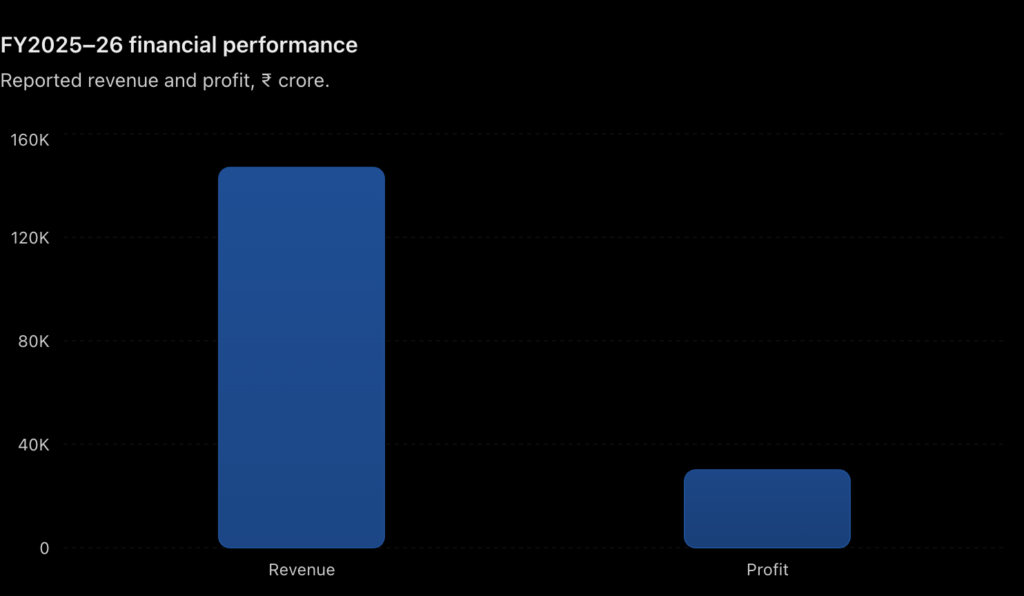
Important reporting distinction: These figures relate to the telecom arm identified in the Reuters report. They should not be labelled as Jio Platforms’ consolidated revenue or profit. For a full IPO valuation analysis, use the relevant audited financial statements and the exact reporting entity specified in the prospectus.
What do these numbers tell us?
Revenue growth: Rising revenue can mean customers are spending more, there are more of them, or the company is selling more services. What matters is where the growth is coming from and whether it will last.
Profit growth: If profit is growing faster than revenue, the company may be running more efficiently. Check whether that comes from the regular business or from one-off items.
Customer scale: A big customer base gives Jio room to sell more services. It doesn’t tell you much on its own, though. Look at average revenue per user, how many customers stay, what the network costs to run, and what it costs to win each new customer.
Cash flow: Profit on paper isn’t cash in hand. Telecom is expensive to run, with heavy spending on networks, spectrum, equipment and technology.
Where Could Jio’s Future Growth Come From?
Whether Jio is worth buying comes down to one thing: can it grow earnings without losing its edge over rivals?
1. 5G and mobile connectivity
People keep using more data, and that means demand for connectivity that works. As consumer and business needs change, Jio could see more network usage and sell more services on top of it. But building and maintaining a network costs a lot, and more data used doesn’t automatically mean more profit.
2. Home broadband
Fixed broadband ties Jio to households and businesses on an ongoing basis. It can also open the door to bundled services, entertainment and connected devices. Keep an eye on customer additions, revenue per connection, churn, and what it costs to build and maintain the network.
3. Enterprise technology
Businesses need connectivity, cloud infrastructure, communications systems and digital tools. Selling these could give Jio revenue beyond individual mobile subscribers. The hard part is winning customers at a profit and keeping them.
4. Digital services and AI
Digital platforms and AI services could add growth, especially as businesses look to automate and consumers use more digital products. Still, a promising market is different from revenue the company has already shown it can earn. AI potential over the long run isn’t guaranteed profit.

How Much Debt Does Jio Have, and Why Does It Matter?
Telecom runs on debt. Building a big network takes a lot of money, so borrowing is part of how these companies are valued.
Reuters reported that Jio Platforms plans to use up to ₹27,500 crore of the net IPO proceeds to repay or prepay borrowings of its telecom subsidiary, Reliance Jio Infocomm. That tells you the offering isn’t only about getting shares onto the market. Cleaning up the balance sheet is part of the goal too.
Before you invest, find out:
- The exact debt outstanding at the relevant reporting date
- Whether the debt sits with Jio Platforms or with one of its subsidiaries
- The interest expense and the repayment schedule
- How much repaying the debt is expected to cut interest costs
- Whether the business will need a lot of new borrowing or capital spending
Paying down debt can lower interest costs and reduce financial risk. How much it helps depends on the final amount used for repayment, the interest rates on that debt, and what the company will need to fund later.
Jio IPO GMP Today: Should Investors Trust It?
The grey market premium, or GMP, is an unofficial indication of the price at which some investors may be willing to trade an IPO application or expected shares before listing.
GMP is not an official exchange price. It can change rapidly, may be based on limited transactions and does not guarantee the actual listing price.
For example, if an IPO has an illustrative issue price of ₹1,000 and an unofficial GMP of ₹220 (19.66%), some market participants might infer an indicative price of ₹1,100. That is only a calculation based on the assumed premium—not a forecast that the shares will list at ₹1,100.
Investors should avoid making decisions based solely on GMP because:
- It can change before the IPO closes.
- It may not reflect actual demand in the official book-building process.
- Market sentiment can change overnight.
- A strong grey market premium does not remove valuation or business risks.
Our view: Treat GMP as a sentiment indicator, not as evidence that an IPO will deliver a profit.

What Are the Main Risks of Investing in the Jio IPO?
Before you apply, it’s worth looking at what could go wrong.
1. High valuation
A big, successful company can still be an expensive buy. If the final valuation assumes very strong growth, even a profitable business can let investors down when earnings come in slower than expected.
2. Competition
Telecom is a crowded, competitive industry. Pricing decisions, customer retention, network quality and capital investment can all hit profitability.
3. Capital expenditure
Network upgrades, spectrum and technology investments can eat up a lot of money. Check whether Jio can pay for them and still keep cash flow healthy.
4. Regulatory changes
Spectrum rules, licensing requirements, regulatory decisions and industry policy all affect telecom operators. A change can push up operating costs, raise investment needs and alter the competitive picture.
5. Execution risk
Broadband, enterprise services and AI aren’t guaranteed to turn profitable at scale. Jio has to turn them into real revenue and earnings.
6. Listing-day volatility
A high-profile IPO can swing sharply after it lists. Demand may look strong beforehand and fade once trading starts, especially if the market turns. Don’t count on a listing gain.
Jio IPO vs Reliance Industries: Are They the Same Investment?
No. Jio Platforms and Reliance Industries are related, but buying shares in the two businesses does not provide identical exposure.
| Factor | Jio Platforms IPO | Reliance Industries shares |
|---|---|---|
| Main investment exposure | Jio’s digital and connectivity businesses | A diversified group with multiple business segments |
| Direct ownership exposure | Determined by the final Jio share offering | Exposure to Reliance Industries as a whole |
| Valuation drivers | Jio’s own earnings, growth, debt and risks | Performance and valuation of the group’s businesses |
| Main question | Is Jio attractive at its IPO valuation? | Is Reliance attractive at its current market valuation? |
A Jio listing could make its standalone valuation more visible. However, investors should not assume that the listing will automatically increase Reliance Industries’ share price.
The effect on Reliance shareholders will depend on the final transaction structure, ownership retained by Reliance, the valuation assigned to Jio and how the market values the remaining Reliance businesses.
How Can Retail Investors Apply for the Jio IPO?
Once the IPO opens, eligible retail investors will generally be able to apply through supported channels such as their broker’s IPO section or a participating bank’s ASBA facility, subject to the applicable issue rules.
A practical checklist:
- Confirm that the IPO is officially open.
- Read the final offer documents and issue details.
- Check the final price band, lot size and minimum application amount.
- Use the required bank account and valid application details.
- Submit the application through a supported platform before the closing deadline.
- Check the application status and allotment through official channels.
- Review your risk tolerance rather than assuming that allotment means a listing profit.
The minimum investment cannot be stated reliably until the final lot size and applicable issue price are verified. Do not use a speculative lot size to estimate the amount required.
Should You Apply for the Jio IPO?
There is no universal answer. The decision should depend on the final offer price, your assessment of the business, your investment horizon and your ability to tolerate losses.
Consider these three scenarios.
The long-term investor: May focus on earnings growth, debt, cash flow, competitive advantages and whether the valuation leaves room for future returns.
The listing-gain investor: May pay closer attention to issue demand, market conditions and valuation, but must accept that listing gains are uncertain and prices can fall.
The cautious investor: May prefer to wait for the final financial disclosures, observe the market’s response and compare the valuation with listed peers before committing money.
Our analytical framework
Rather than labelling the IPO a definite buy or avoid, evaluate it against these questions:
- Does the final valuation look reasonable relative to earnings and cash flow?
- Is profit growth supported by recurring business operations?
- How much debt remains after the proposed repayment?
- Can Jio sustain its competitive position without excessive spending?
- Are future growth expectations supported by measurable operating results?
- Would the investment still make sense if the shares listed below the issue price?
If these questions cannot be answered using the final offer documents, there is not enough information to make a well-supported investment decision.

Jio IPO 2026: Frequently Asked Questions
Is the Jio IPO confirmed?
Jio Platforms has published IPO-related documents, and SEBI lists its draft offer document. However, investors should verify the latest official issue status and definitive terms before applying.
What is the expected Jio IPO price?
Reuters reported a price band of ₹1,065–₹1,119 per share. Check the final offer documents to confirm the applicable price band.
What is the expected Jio IPO valuation?
Reuters reported a targeted valuation of approximately ₹10.3 lakh crore. A valuation target reported before the final offer is not a guarantee of the eventual market capitalisation.
What is the Jio IPO opening date?
Use the official Jio Platforms IPO page and final offer documents for the confirmed opening date. Do not rely on an estimated date without verification.
What is the Jio IPO lot size?
The lot size should be confirmed from the final issue details. The minimum application amount depends on the final lot size and the price applicable to the application.
What is the Jio IPO GMP today?
GMP for Jio IPO on 17th October is ₹220 (19.66%).
Will Reliance Industries shareholders get Jio IPO shares?
Do not assume that Reliance shareholders will automatically receive Jio shares or a special entitlement. Any shareholder reservation, eligibility requirement or other benefit must be verified in the final offer documents.
Is the Jio IPO good for long-term investment?
That depends on the valuation, earnings outlook, debt, competition and risks at the time of the offering. A recognised brand and large customer base do not, by themselves, establis
Final Takeaway
The Jio IPO is worth examining because it could give public-market investors direct exposure to a large digital and telecommunications business. Its scale, connectivity infrastructure and opportunities in broadband, enterprise technology and digital services make the business important to watch.
But the investment decision should come down to fundamentals rather than excitement.
The most useful approach is to verify the final IPO terms, understand the company’s financial reporting structure, evaluate debt and cash flow, compare valuation with relevant listed businesses and consider the risks before applying.
Remember: A good company is not automatically a good investment at every price.
Disclaimer: This article is for educational and informational purposes only. It is not investment advice or a recommendation to apply for or avoid any IPO. IPO details can change. Verify the latest disclosures with Jio Platforms, SEBI and the relevant stock exchanges before making an investment decision.h that a share is attractively priced.