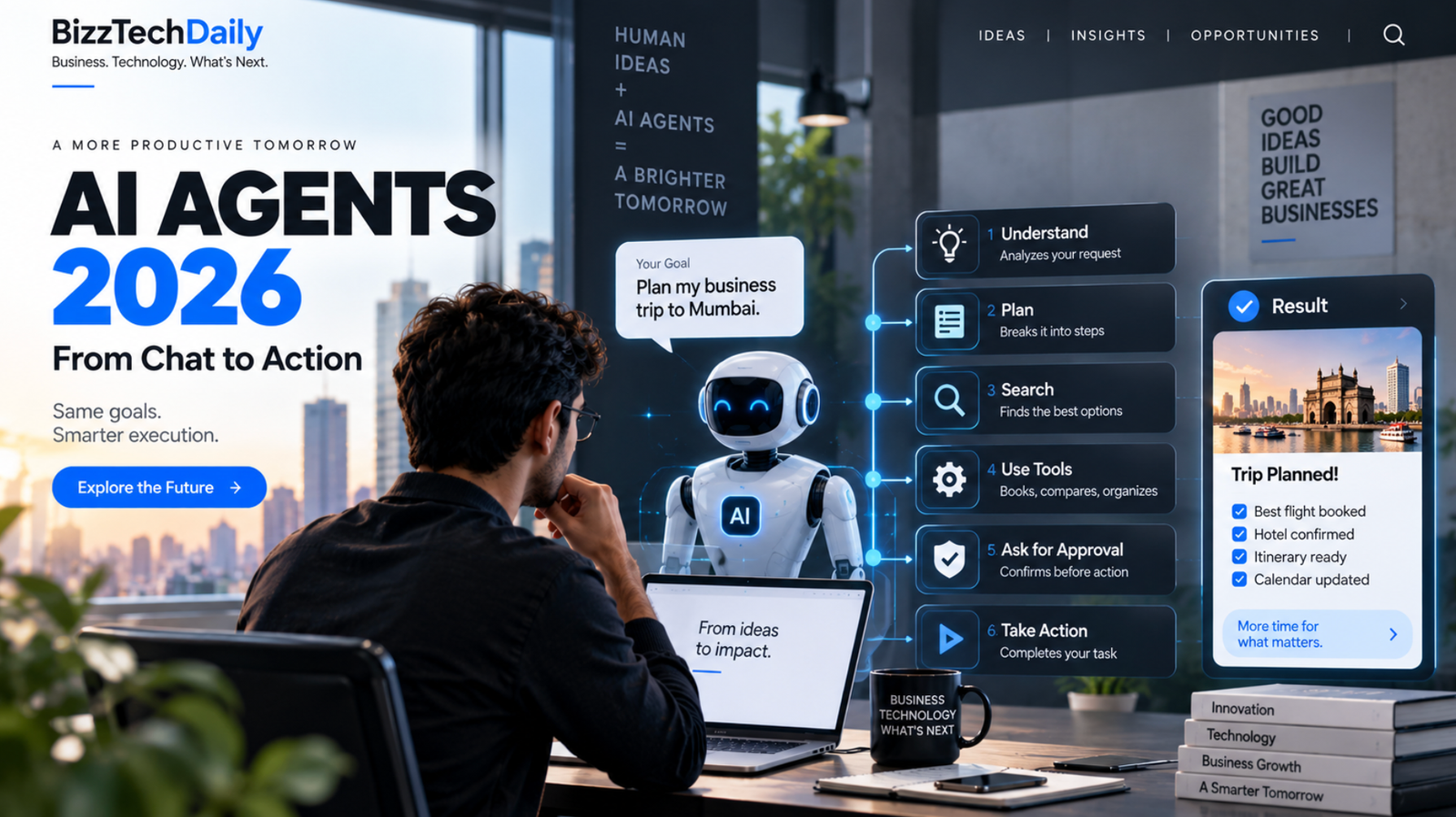
You don’t ask AI what flight to book.
You tell it where you want to go, your budget and your preferences.
The AI searches.
Compares.
Checks your calendar.
Finds the right option.
And, with your permission, takes the next action.
That’s the shift from AI assistant to AI agent.
AI agents 2026 represent a shift from AI that simply answers questions to AI that can increasingly plan, use tools and take action.
For years, AI mostly waited for instructions and returned answers. In 2026, the technology is increasingly being designed to work through multi-step tasks using connected tools and systems. Google, OpenAI and enterprise AI platforms are all pushing toward this more agentic model.
⚡ QUICK TAKE
AI isn’t just becoming better at answering. It’s becoming better at doing.
| THEN | NOW |
|---|---|
| 💬 Ask a question | 🎯 Give it a goal |
| 📝 Get an answer | 🧠 Let it plan |
| 🔗 Open the links yourself | 🔧 Let it use tools |
| 👤 You execute the task | 🤖 Agent handles steps |
| ✅ You check the result | 🛡️ Agent reports/asks for approval |
AI isn’t just becoming better at answering. It’s becoming better at doing.
What Exactly Is an AI Agent?
An AI agent is more than a chatbot with a better answer.
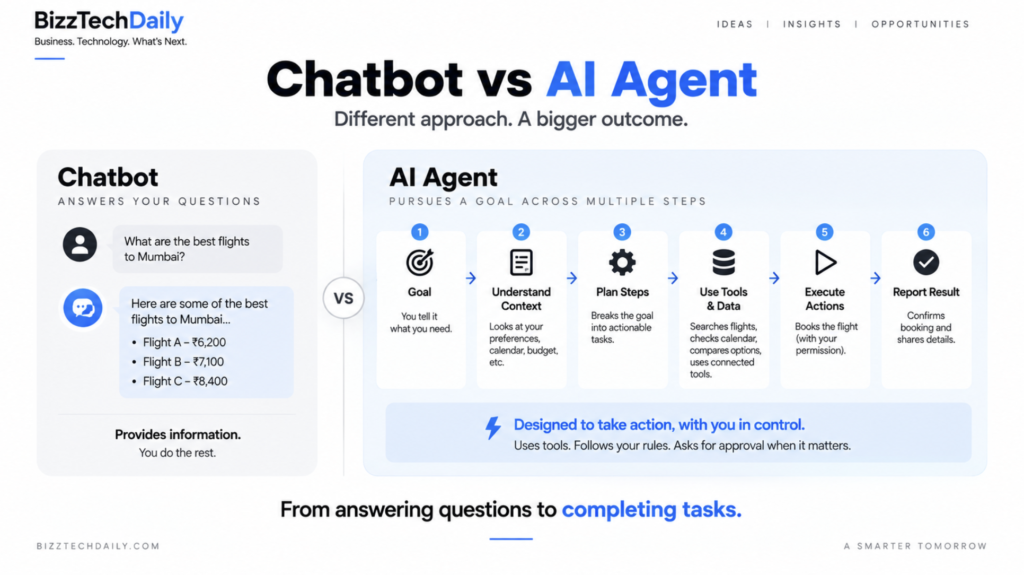
A chatbot typically responds to the instruction you give it. An AI agent is designed to work toward a goal, deciding what steps are needed, using available tools or information, and carrying out parts of the task within the permissions you give it. The rise of AI agents in 2026 is making this distinction increasingly important for businesses and everyday users.
The simplest way to understand it
Chatbot:
“Here are five flights to Mumbai.”
AI Agent:
“I found flights that match your budget and schedule, compared the options, checked your calendar, and I’m ready to book the one you selected.”
The important change isn’t simply better answers.
It’s goal → planning → tools → action → result.
Google’s current agent products illustrate this shift. Gemini Spark is designed to work with connected tools and carry out tasks under the user’s direction, while Google’s developer tooling is increasingly focused on agents that can interact with browser, desktop and other environments.
A useful distinction
An AI system starts looking more agentic when it can combine several capabilities:
- 🧠 Understand a goal rather than just a question
- 🗺️ Break the goal into steps
- 🔎 Gather information
- 🔧 Use tools and connected systems
- 🔄 Adapt when something changes
- ⚡ Take actions
- 🛡️ Operate within permissions and approval rules
This doesn’t mean every AI agent operates completely autonomously. In many real-world systems, humans remain involved at important decision points—particularly when actions involve sensitive information, money or external communication. Google’s Spark, for example, is designed to ask before certain high-stakes actions.
💡 BizzTechDaily Insight
The defining shift isn’t that AI can think. It’s that AI can increasingly connect thinking with tools and execution.
That’s why the rise of AI agents could affect not just how people use AI, but how businesses design workflows.
McKinsey’s 2026 research shows that organizations are increasingly moving toward agentic AI, although scaling remains much less widespread than chatbot deployment.
How an AI Agent Actually Works
| Step | What the agent does | Example: Business trip to Mumbai |
|---|---|---|
| 🎯 1. Goal | Understands the desired outcome | “Plan my Mumbai business trip under ₹15,000.” |
| 🧠 2. Understand | Interprets context, preferences and constraints | Dates, budget, preferred timings, meetings |
| 🗺️ 3. Plan | Breaks the goal into smaller tasks | Find flights → compare → check hotels → build itinerary |
| 🔎 4. Gather | Searches information and uses connected tools | Flight data, hotel availability, calendar |
| ⚙️ 5. Act | Performs permitted actions | Prepare booking, update calendar, create itinerary |
| ✅ 6. Report | Shows the result and requests approval where needed | “I found 3 options. Shall I proceed with Option 1?” |
The key difference: A chatbot primarily responds to a prompt. An AI agent works toward an outcome by combining reasoning, planning, tools and actions.
Where AI Agents Are Actually Being Used
AI agents are moving beyond experiments and into specific workflows where the system can access the right information, tools and permissions.
The most visible early use cases are appearing in software development, research, sales, marketing, customer support and internal operations. OpenAI’s 2026 enterprise data, for example, shows agentic usage spreading beyond engineering into legal, sales, recruiting and marketing
📊 AI Agents Across Different Workflows
| Area | What the agent can do | What changes |
|---|---|---|
| 💻 Software Development | Write, test, debug and refactor code; work across repositories | Developers move from writing every step to delegating larger tasks |
| 🔎 Research | Search sources, collect information, compare findings and prepare reports | Research becomes more multi-step and less manual |
| 📈 Sales | Research prospects, qualify leads, prepare outreach and update CRM systems | Repetitive sales operations can be delegated |
| 📣 Marketing | Turn a campaign brief into content, emails, ads and landing-page drafts | One brief can trigger multiple connected tasks |
| 🎧 Customer Support | Understand requests, access company systems, resolve approved issues and escalate when needed | AI can move from answering FAQs toward resolving cases |
| 👥 Recruiting & HR | Research candidates, organize information and support recruiting workflows | Administrative work can be reduced |
| 📊 Data & Operations | Analyze data, create reports, update systems and coordinate workflows | Teams can spend less time moving information between tools |
| 🏢 Business Operations | Connect multiple internal systems and execute repeatable processes | Workflows can become partially or fully agent-driven |
OpenAI reports that weekly active enterprise Codex users grew sharply from February to June 2026 across legal, sales, recruiting and marketing, illustrating how agentic tools are spreading beyond traditional software development.
McKinsey’s 2026 survey similarly found that 40% of respondents from organizations with more than $1 billion in annual revenue reported scaling AI agents, compared with 22% among smaller organizations.
🔥 The Bigger Change
The important part isn’t that AI can perform these individual tasks.
It’s that one agent can potentially connect several tasks together.
For example:
Traditional workflow
Research prospect → write email → send for approval → update CRM → schedule follow-up
The human may have to move information between several tools.
Agentic workflow
“Prepare and follow up with qualified leads from this week’s campaign.”
The agent could potentially:
Find → Research → Qualify → Draft → Ask for approval → Update CRM → Schedule follow-up
That’s where the technology starts becoming more than an AI assistant.
💡 BizzTechDaily Insight
The next productivity jump may not come from AI answering questions faster. It may come from AI reducing the number of steps humans have to coordinate.
And this is why businesses are increasingly looking at workflows, rather than simply asking which AI model produces the best answers.
Why India Could Become a Major Test Ground for AI Agents
Why India Could Become a Major Test Ground for AI Agents
India already has one of the world’s largest real-time digital payment ecosystems. NPCI reports that UPI processed 24.51 billion transactions worth ₹29.82 trillion in August 2026.
That scale becomes particularly interesting when combined with AI agents.
Imagine telling an AI:
“Order my usual groceries when they fall below ₹1,500.”
Instead of simply finding the products, an agent could eventually be able to:
Understand your instruction → check prices → select products → apply your rules → initiate payment → confirm the order.
That is the basic idea behind agentic commerce.
💳 From UPI Payments to Agentic Payments
In September 2026, Reuters reported that India was developing a framework that could allow AI agents to make certain low-value UPI payments without requiring the user to approve every individual transaction. The reported framework includes concepts such as spending limits, rule-based payments, identity checks and mechanisms for delegating funds.
This is important because it changes the role of AI from:
“Help me decide what to buy.”
to potentially:
“Buy it for me according to the rules I’ve given you.”
The distinction is small in language—but potentially significant for how digital commerce works.
A simple comparison
| Today | Agentic Commerce |
|---|---|
| User searches for a product | Agent searches |
| User compares options | Agent compares |
| User chooses | Agent can shortlist based on rules |
| User opens payment app | Agent initiates permitted payment |
| User authorizes each transaction | Predefined limits/rules could govern certain transactions |
| User tracks the order | Agent can potentially track and report |
Important: The agentic-payment framework reported by Reuters was still under development, so these should be presented as the direction being explored, not as a feature every Indian consumer can already use.
🔐 The Big Question: How Much Control Should an Agent Have?
This is where agentic commerce gets complicated.
If an AI can spend money, users need much stronger controls than they need for an ordinary chatbot.
Possible safeguards include:
- Spending limits
- Merchant restrictions
- Transaction limits
- Identity verification
- User-defined rules
- Approval requirements for larger purchases
- Transaction records and notifications
The reported Indian framework specifically points toward mechanisms such as rule-based payments, spending limits, identity checks and liability provisions.
Meanwhile, NPCI is already using AI within the UPI ecosystem for conversational support. Its UPI Help Assistant is designed to answer payment-related questions and help with certain UPI-related tasks.
So India isn’t starting from zero.
The ecosystem is gradually moving through:
Digital payments → AI-assisted payments → AI-enabled workflows → Potential agentic payments
💡 BizzTechDaily Insight
India’s advantage may not simply be that it has advanced AI models. It is that AI could eventually connect to an enormous existing digital infrastructure of payments, commerce and services.
If that happens at scale, the next generation of AI assistants may not just search the internet for you.
They may increasingly act on the internet for you.
What AI Agents Mean for Businesses
What AI Agents Could Mean for Businesses
The biggest business impact of AI agents may not come from replacing one specific job or software tool.
It could come from changing how work moves through an organization.
Today, many business processes look like this:
Person → Tool → Person → Tool → Approval → Another Tool → Result
An agentic workflow aims to reduce some of that coordination:
Goal → AI Agent → Multiple Tools → Human Approval Where Needed → Result
OpenAI’s 2026 enterprise research describes this shift as a move from AI assistance toward delegation and execution, with agents increasingly connected to company context, tools and repeatable workflows.
⚡ The Real Business Opportunity
The interesting question isn’t:
“Where can we add AI?”
It’s:
“Which workflow contains too many repetitive steps that an AI agent could safely coordinate?”
For example, imagine a digital marketing agency receiving a new client.
Traditional process
Client brief
↓
Keyword research
↓
Competitor research
↓
Content plan
↓
Ad ideas
↓
Campaign structure
↓
Reporting
↓
Client approval
A future agentic workflow could potentially coordinate much of this:
Client brief → Research → Strategy draft → Content/ads → Report → Human approval
The human doesn’t disappear from the workflow.
Instead, the human can move toward reviewing, deciding and directing, while the agent handles more of the repetitive coordination.
⚠️ But There’s a Catch
More autonomy doesn’t automatically mean better results.
Businesses still need:
- Reliable data
- Clear permissions
- Human oversight
- Security controls
- Evaluation and monitoring
- Well-designed workflows
McKinsey’s September 2026 analysis notes that many companies are scaling agents faster than they are redesigning the underlying work, making workflow design and governance increasingly important.
💡 BizzTechDaily Insight
The companies that benefit most from AI agents may not be the ones with the most AI tools. They may be the ones that redesign their workflows around what agents can safely execute.
What Can Go Wrong?
The Risks: When AI Can Actually Take Action
An AI that gives you a wrong answer is one problem.
An AI that gives you a wrong answer and then acts on it is a much bigger problem.
That’s the central challenge with agentic AI.
As AI systems gain access to email, files, browsers, business software and potentially payment systems, organizations need to think about what the agent is allowed to access, what actions require approval and what happens when the system makes a mistake.
📋 The Agentic AI Risk Map
| Risk | What could happen | Why it matters |
|---|---|---|
| ❌ Wrong decisions | Agent misunderstands the user’s objective | The wrong action could be taken automatically |
| 🔐 Excessive permissions | Agent gets access to more systems than necessary | A mistake could affect multiple systems |
| 🕵️ Privacy | Agent processes sensitive company or personal information | More connected tools mean more data exposure |
| 🎭 Prompt injection | Malicious instructions influence an agent through external content | An agent may be manipulated into taking unintended actions |
| 💸 Financial loss | Agent performs an unauthorized or incorrect transaction | Automation can turn a small error into a real cost |
| 🔄 Unexpected actions | Agent takes a technically valid but unintended step | The system may follow the instruction differently than the user expected |
| 👤 Accountability | It’s unclear who is responsible for an agent’s action | Businesses need clear ownership and audit trails |
🛡️ The New Rule: Give Agents Boundaries
The solution isn’t necessarily to prevent AI agents from taking action.
It’s to control what they can do.
A well-designed agentic system can use boundaries such as:
What can it see?
↓
What can it change?
↓
What can it spend?
↓
What requires approval?
↓
What gets logged?
For example:
An agent might be allowed to prepare an email automatically but require human approval before sending it.
Or:
An agent might be allowed to make purchases below a predefined limit but require approval for anything above it.
Google’s current agent products already demonstrate this principle, with approval required for certain high-stakes actions such as spending money or sending emails.
🧠 Human-in-the-Loop
This is where the concept of human-in-the-loop becomes important.
Instead of:
AI → Do everything
the safer model for many business processes may be:
AI → Prepare → Human reviews → AI executes
For low-risk, repetitive tasks, businesses may eventually allow more autonomy.
For high-risk actions involving money, legal decisions, sensitive data or external communication, stronger controls may be appropriate.
💡 BizzTechDaily Insight
The more capable an AI agent becomes, the more important its boundaries become.
The future of agentic AI isn’t simply about giving machines more autonomy.
It’s about finding the right balance between autonomy and control.
The Agentic Internet: When AI Becomes the User
For decades, the internet has largely been designed around humans clicking, searching, comparing and buying.
You open Google.
You search for something.
You open websites.
You compare options.
You fill out forms.
You make a payment.
But what happens when an AI agent starts doing those steps for you?
The internet could gradually shift from being a place where people perform tasks to an environment where people give goals and agents coordinate the tasks.
This shift also connects with the broader evolution of AI-powered search, where AI is increasingly moving beyond returning links toward understanding and completing more complex tasks.
🌐 From Human Internet to Agentic Internet
| Today’s Internet | Agentic Internet |
|---|---|
| 👤 Human searches | 🤖 Agent searches |
| 🖱️ Human opens websites | 🤖 Agent interacts with services |
| 🔍 Human compares options | 🧠 Agent compares according to preferences |
| 🛒 Human chooses products | 🎯 Agent can shortlist based on rules |
| 💳 Human completes payment | 💰 Agent may initiate permitted transactions |
| 📧 Human manages follow-ups | 🔄 Agent can coordinate follow-up tasks |
| 📋 Human moves information between apps | 🔗 Agents connect multiple tools |
The important change isn’t that websites disappear.
Instead, the interface between businesses and customers could change.
🏪 What Happens to Businesses?
Consider an online store.
Today, a customer might search:
“Best wireless headphones under ₹5,000.”
The business competes for:
- Search rankings
- Clicks
- Website visits
- Product-page views
- Conversions
But an AI agent could eventually ask a different question:
“Which product best matches my user’s requirements?”
It might evaluate price, specifications, reviews, delivery time, return policies and previous preferences before presenting a shortlist.
That could change how businesses think about digital visibility.
The goal may increasingly become:
Be understandable and trustworthy to both humans and machines.
🔎 Search Could Change Too
This connects directly with the broader shift we explored in our AI-powered search coverage.
Traditional search largely gives users a list of links.
Agentic systems can potentially turn that search into a multi-step process:
Search → Understand → Compare → Decide → Act
Google’s 2026 announcements point toward this direction, with agentic experiences being developed across Search and other products, including systems designed to carry out tasks rather than simply return information.
That could have major implications for:
- SEO
- E-commerce
- Online advertising
- Websites
- Marketplaces
- Customer acquisition
- Digital payments
⚠️ But Don’t Call This the “End of Websites”
That’s an important distinction.
AI agents still need reliable information, structured data, APIs, authentication and permission systems to accomplish tasks.
Businesses therefore have a reason to make their digital infrastructure machine-readable and agent-friendly, rather than simply optimizing it for human visitors.
The emerging question isn’t:
“Will AI replace the internet?”
It’s:
“Will the internet increasingly become infrastructure that AI agents operate through?”
💡 BizzTechDaily Insight
The next version of the internet may be less about where humans click—and more about what humans ask machines to accomplish.
We’re not there yet.
But the building blocks are appearing: AI agents, connected tools, agentic search, automated workflows and emerging agentic commerce.
And if those pieces connect at scale, the relationship between people, businesses and the internet could look very different.
The AI Agent Maturity Ladder
From Chatbots to Autonomous Agents: The AI Agent Maturity Ladder
Not every AI system that uses the word agent has the same level of autonomy.
A useful way to understand the progression is to look at how much the AI can do without being guided through every individual step.
| Level | System | What it does | Human involvement |
|---|---|---|---|
| 1 | 💬 Chatbot | Answers questions and generates content | High — human directs every task |
| 2 | 🤝 AI Assistant | Helps with tasks and can use limited context | High — human remains the primary operator |
| 3 | 🔧 Tool-Using Agent | Uses search, APIs, files or other tools to complete a task | Medium — human provides the goal and permissions |
| 4 | 🔄 Workflow Agent | Coordinates multiple steps across connected systems | Medium to low — human supervises the workflow |
| 5 | 🤖 Autonomous Agent | Can pursue defined goals and make decisions within established boundaries | Lower — human sets objectives, limits and oversight |
The progression looks like this:
Answer → Assist → Use Tools → Execute Workflows → Operate Within Boundaries
The important point is that autonomy isn’t binary.
An AI system doesn’t suddenly go from “chatbot” to “fully autonomous employee.”
There are different levels of capability, tool access, decision-making and human oversight.
🎯 Why This Matters for Businesses
For a business, the most useful question may not be:
“Should we use AI agents?”
Instead:
“Which level of autonomy makes sense for this particular workflow?”
For example:
Writing a first draft
→ Low-risk → more automation may be appropriate.
Updating a CRM
→ Moderate-risk → permissions and monitoring matter.
Sending customer communications
→ Human approval may still be valuable.
Making financial transactions
→ Stronger controls and explicit limits become critical.
This is why agentic AI adoption isn’t simply a technology decision. It is also a workflow design and governance decision. McKinsey’s 2026 research highlights the importance of redesigning work and establishing appropriate governance as organizations scale agentic AI.
💡 BizzTechDaily Insight
The future isn’t necessarily “fully autonomous AI.” It’s AI operating at the right level of autonomy for the job.
A marketing agent might be allowed to research competitors automatically but require approval before launching an advertising campaign.
A finance agent might prepare a payment but require authorization before executing it.
The winning model will depend on risk, trust, permissions and the value of automation.
What Happens Next?
The Future of AI Agents: From Assistants to Digital Operators
The biggest change brought by AI agents may not be a single breakthrough.
It may be the gradual shift in who performs the work.
For years, software has required people to tell it what to do, one step at a time.
AI agents introduce a different model:
Tell the system what you want to achieve — and let it figure out some of the steps.
That could eventually affect how people:
- Search for information
- Shop online
- Manage businesses
- Write and develop software
- Handle customer service
- Conduct research
- Manage personal tasks
- Make digital payments
But the transition won’t happen overnight.
Agents still face major challenges involving accuracy, security, permissions, reliability and human oversight. Businesses also need to redesign workflows rather than simply add an AI tool on top of existing processes.
🚀 The Real Shift
The evolution can be summarized simply:
Chatbots
“Here is your answer.”
↓
AI Assistants
“I’ll help you with the task.”
↓
AI Agents
“I’ll work through the task using the tools you’ve given me.”
↓
Agentic Internet
“I’ll coordinate across services to accomplish your goal.”
The last stage is still emerging. But the pieces are already being developed across AI platforms, enterprise software, search and digital commerce.
💡 BizzTechDaily Final Take
AI agents may represent a shift from an internet we operate to an internet that increasingly operates on our behalf.
The important question for businesses isn’t whether every process should become autonomous.
It’s which parts of their work are structured, repetitive and safe enough to delegate — and where humans should remain firmly in control.
That distinction could define how useful—and how trustworthy—the next generation of AI becomes.
📌 One-line conclusion
2026 may be remembered not simply as the year AI became smarter, but as the period when AI increasingly began moving from answering questions to taking action.
❓ Frequently Asked Questions About AI Agents
1.What are AI agents?
AI agents are AI systems designed to work toward a goal by understanding instructions, planning steps, using tools or connected systems, and taking permitted actions. Unlike a basic chatbot, an agent can potentially handle multiple steps of a task rather than simply returning an answer.
2. How are AI agents different from chatbots?
A chatbot primarily responds to user prompts, while an AI agent can combine reasoning, planning, tool use and execution to accomplish a broader task. The level of autonomy depends on how the agent is designed and what permissions it has.
3. What can AI agents be used for?
AI agents can support workflows such as software development, research, marketing, sales, customer service, data analysis and business operations. Their usefulness depends on the tools, information and permissions available to the system.
4. Are AI agents available in India?
Yes. AI-agent capabilities are increasingly being introduced in products and services available to Indian users. Google, for example, has introduced Gemini Spark in India, while India is also exploring frameworks for agentic UPI payments. Availability and capabilities vary by product and use case.
5. How will AI agents affect businesses?
AI agents could automate or coordinate repetitive, multi-step workflows, allowing employees to spend more time on decision-making, strategy and oversight. Businesses will also need to consider security, permissions, governance and workflow redesign.
6. Are AI agents safe?
AI agents can introduce additional risks because they may have access to tools, data and external systems. Risks include incorrect actions, excessive permissions, privacy issues, prompt injection and financial or operational mistakes. Human approval and clearly defined boundaries can be important for higher-risk tasks.
Sources & Further Reading
- Google India — Gemini Spark — Google’s overview of Gemini Spark and its agentic capabilities in India.
- Google — Gemini and Agentic AI Updates — Google’s 2026 announcements around agents, Search and AI development.
- OpenAI — Enterprise AI Signals — Enterprise adoption and agentic AI usage data.
- McKinsey — The State of AI — Research on organizational AI and agent adoption.
- Reuters — Agentic Payments on UPI — Reporting on India’s development of agentic UPI payments.
- NPCI — UPI Product Information — Official information about India’s UPI ecosystem.