What Changed in 2026? The AI Problem Has Moved
Imagine a company where a customer sends a WhatsApp message asking for a quotation.
Today, the workflow might look something like this:
Customer message → employee reads it → checks product information → prepares quotation → checks availability → sends quotation → updates CRM.
The AI assistant can help with several of those steps.
But an AI agent changes the question.
Instead of asking:
“Can AI help my employee prepare this quotation?”
the business can start asking:
“Can AI handle this workflow, while a person approves the important decisions?”
That is a much bigger change.
The technology is moving toward systems that can work across multiple steps and interact with tools rather than simply producing text. Recent developments from major AI companies and enterprise research show increasing attention toward agents that can operate with business context, connected tools and repeatable workflows.
But here’s the part businesses can easily overlook:
The agent may not be the hardest part.
A company can buy or build an AI agent tomorrow.
What it cannot instantly fix is a messy business process.
If customer information is spread across WhatsApp, Excel files and different employees’ inboxes, an agent doesn’t magically turn that into a reliable workflow.
If nobody has documented how a refund should be approved, giving an AI access to the refund system doesn’t solve the underlying problem.
AI Agents in 2026: How AI Is Moving From Chat to Action
If every employee has different rules for handling leads, the agent has no consistent process to follow.
This creates an interesting paradox:
The more capable AI agents become, the more clearly businesses can see weaknesses in their own operations.
From “Using AI” to “Delegating Work”
This is where 2026 feels different.
| Earlier AI adoption | Agent-era adoption |
|---|---|
| “Let’s use AI to write our emails.” | “Can AI manage the first stage of email handling?” |
| “Let’s generate sales reports.” | “Can AI collect the data and prepare the report automatically?” |
| “Let’s create marketing content.” | “Can AI monitor campaigns and identify what needs attention?” |
| “Let’s build a customer-service chatbot.” | “Can an agent resolve routine customer requests across our systems?” |
| “Let’s analyze invoices.” | “Can an agent process invoices and flag exceptions?” |
The second column isn’t automatically better or safer. It simply involves a much higher level of delegation.
And that is the real business story behind AI agents in 2026.
Companies are no longer deciding only whether they should use AI.
They’re beginning to decide:
What work should AI be allowed to do, what should require human approval, and what should remain completely human?
That is the question we’ll use throughout this article.
McKinsey's research on scaling agentic AI
Why Businesses Are Moving From AI Assistants to AI Agents
The easiest way to understand the difference is to look at where the human sits in the workflow.
With a traditional AI assistant, the human is usually the operator.
You ask AI to write an email.
You review it.
You copy the information into another system.
You send it.
You decide what happens next.
With an agent, the human can become more of a supervisor.
For example, consider a company’s incoming sales leads.
A conventional AI tool might summarize the lead and suggest a reply.
An agent could potentially:
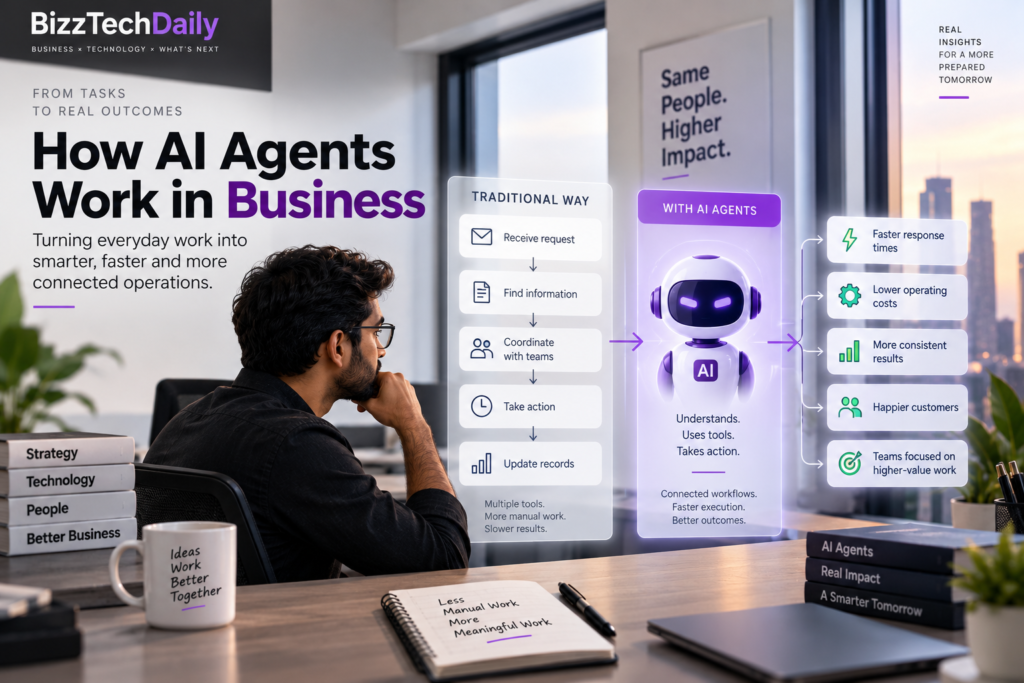
receive the lead → identify the customer’s requirement → check available information → qualify the lead → update the CRM → prepare a response → ask for approval before sending it.
That difference matters because businesses don’t ultimately pay employees to generate AI outputs. They pay them to get work completed.
The real opportunity: fewer handoffs
Many business processes contain small handoffs that individually look insignificant but collectively consume a surprising amount of time.
Consider a simple marketing workflow:
| Step | Traditional process | Agent-assisted process |
|---|---|---|
| Lead arrives | Employee checks message | Agent identifies incoming lead |
| Information | Employee searches records | Agent retrieves permitted information |
| Qualification | Employee checks criteria | Agent applies defined rules |
| CRM | Employee enters details | Agent updates the record |
| Follow-up | Employee remembers to respond | Agent prepares the next action |
| Exception | Employee handles everything | Agent sends unusual cases to a person |
The interesting part isn’t that AI can write the follow-up message.
The bigger opportunity is reducing the number of times a person has to move information from one step to another.
That is where agents could become valuable.
But automation isn’t automatically the answer
There’s an important distinction between automating a task and delegating a decision.
A business might reasonably allow an agent to:
- organize incoming enquiries
- summarize documents
- classify support tickets
- prepare reports
- update approved records
- identify routine follow-ups
The same business may want a human to approve:
- large payments
- refunds above a threshold
- employee decisions
- contractual commitments
- sensitive customer actions
- changes that could create significant financial or legal consequences
So the question shouldn’t be:
“How much of our business can we automate?”
A better question is:
“Which parts of our workflow are predictable enough to delegate, and where does human judgment still matter?”
That distinction becomes increasingly important as agents gain access to more company systems.
OpenAI's practical guide to AI agents
The Biggest Problem Isn’t the AI — It’s the Business
A company can have access to an excellent AI model and still be completely unprepared to use an AI agent.
Why?
Because agents need something to work with.
Imagine a company wants an agent to handle incoming customer enquiries. The company has:
- customer information in a CRM,
- product prices in spreadsheets,
- inventory information in another system,
- conversations on WhatsApp,
- and important instructions sitting inside employees’ heads.
The AI might be capable of reasoning across all of this.
The business environment isn’t.
This is one of the less obvious challenges of agent adoption: AI can expose operational problems that were previously hidden behind human effort.
A workflow doesn’t become good just because AI is added
Take a simple refund process.
Suppose the company says:
“Let the AI agent handle refunds.”
Before doing that, someone needs to answer questions such as:
- Which refunds can be approved automatically?
- What amount requires human approval?
- Where does the agent get the original order information?
- What happens when payment data doesn’t match?
- Who handles exceptions?
- What should happen if the customer disputes the decision?
If these rules aren’t clear for employees, they won’t suddenly become clear for an AI agent.
That’s why workflow quality becomes an AI-readiness issue.
The four things an agent needs
We can simplify the problem into four layers:
| Layer | The business needs | What happens if it’s missing? |
|---|---|---|
| Data | Reliable information in accessible systems | Agent may work with incomplete context |
| Workflow | Clearly defined steps and rules | Agent doesn’t know what should happen next |
| Tools | Controlled access to relevant software | Agent can understand the task but can’t complete it |
| Governance | Permissions, approvals and boundaries | Automation can create unacceptable risks |
This also explains why simply buying an “AI agent” isn’t an AI strategy.
The agent is only one component.
The surrounding business system determines what that agent can actually accomplish.
The hidden cost of messy processes
There’s another reason this matters.
When a workflow is inefficient, humans compensate for it.
An employee notices that a spreadsheet is outdated.
Someone remembers a special pricing rule.
A manager knows which customer needs personal attention.
Those informal corrections may keep the business running.
An agent doesn’t automatically have that institutional knowledge.
So businesses considering agents may first need to do something much less exciting:
document the process, clean up the data, connect the systems and define the boundaries.
That work doesn’t make for flashy AI demos.
But it could determine whether an agent becomes a useful business tool—or simply another technology experiment that never makes it beyond the pilot stage.
Where AI Agents Can Actually Create Value
The most useful place to deploy an AI agent isn’t necessarily the task that looks most impressive in a demo.
It’s usually the task that has clear inputs, repeatable steps and an obvious definition of success.
That gives businesses a practical starting point.
Think workflow first, agent second
Consider these examples:
| Business area | What an agent could handle | Human role |
|---|---|---|
| Sales | Qualify incoming leads, collect missing information and prepare follow-ups | Approve important prospects or offers |
| Customer support | Classify requests, retrieve account information and resolve routine issues | Handle unusual or sensitive cases |
| Marketing | Monitor campaign data, identify anomalies and prepare reports | Decide strategy and budget |
| Finance | Organize invoices, match information and flag exceptions | Approve payments and financial decisions |
| Operations | Track recurring tasks and coordinate information between systems | Manage exceptions |
| Research | Gather information from approved sources and produce a structured brief | Verify important conclusions |
The common pattern is more important than the individual use case.
The agent isn’t replacing an entire department. It’s taking responsibility for a defined piece of a workflow.
The best early use cases are often boring
This is where businesses can make a useful distinction.
A flashy AI demonstration might involve an agent autonomously running a complicated project.
But a company could get more measurable value from something far less exciting:
Every morning, check the previous day’s leads, identify those that haven’t received a response, gather the relevant customer information and prepare a follow-up list for the sales team.
That’s repetitive work.
It has a clear starting point.
It has relatively clear rules.
And its outcome can be measured.
If the system saves the sales team two hours every day without increasing mistakes, the business has something tangible to evaluate.
A simple test for potential agent workflows
Before giving an agent access to a process, businesses can ask five questions:
1. Is the task repeated frequently?
A one-time task may not justify building an automated workflow.
2. Are the rules reasonably clear?
If employees constantly disagree about what should happen next, automation becomes harder.
3. Does the agent have the information it needs?
Missing or unreliable data can undermine the entire process.
4. Can mistakes be detected or reversed?
A workflow is easier to delegate when an error doesn’t immediately create serious consequences.
5. Can the result be measured?
If the company cannot determine whether the agent saved time, reduced cost, improved response times or increased conversions, it becomes difficult to justify the investment.
This gives businesses a more useful way to evaluate AI agents than simply asking:
“What can this AI do?”
The better question is:
“Which repetitive business outcome can we delegate without losing control?”
Where Businesses Should Be Careful
An AI agent becomes more useful as it receives more access.
It can see more information.
It can use more tools.
It can change more records.
It can take more actions.
But that creates a simple trade-off:
More access can create more value — and more ways for something to go wrong.
This is different from the risk of a normal chatbot giving you a bad answer. If an agent is connected to business systems, a mistake can potentially become an actual business action.
For example, an incorrect answer in a report can be corrected.
An incorrectly processed refund, wrongly changed customer record or unauthorized external message may require much more work to reverse.
Security researchers and enterprise AI guidance increasingly emphasize this distinction: organizations need to control what agents can access, what they can do, and when a person must intervene. OpenAI
Not every decision should be delegated
A practical way to think about agent deployment is to divide work into three levels:
| Level | Example | Appropriate approach |
|---|---|---|
| 🟢 Low risk | Sort enquiries, summarize documents, prepare reports | Agent can often execute |
| 🟡 Medium risk | Update CRM records, prepare customer responses, recommend refunds | Agent prepares → human reviews |
| 🔴 High risk | Large payments, sensitive financial actions, major contractual decisions | Human approval should remain central |
The exact boundaries will differ between businesses, industries and workflows.
But the principle is useful:
Don’t give an agent maximum autonomy simply because the technology allows it.
Permissions matter more than the demo
Imagine giving a marketing agent access to:
- your CRM,
- advertising platform,
- customer database,
- email account,
- payment system.
It may sound powerful.
But does that agent really need access to all five?
Probably not.
A better design is to give the agent only the permissions required for its specific job.
This approach—often described as least-privilege access—is becoming an important part of enterprise agent governance. Current enterprise agent platforms are adding role-based controls, audit logs and approval gates for precisely this reason. OpenAI Help Center
The approval button may become a business control
Human involvement doesn’t necessarily mean checking every action manually.
Instead, businesses can define approval points.
For example:
Agent finds a suitable supplier → checks price → prepares purchase order → asks manager for approval → proceeds after approval.
That is very different from:
Agent finds supplier → automatically spends ₹2 lakh.
The first approach keeps the speed of automation while retaining a clear decision boundary.
And that may become one of the most important design questions for businesses adopting agents:
Where should the agent stop and ask a human?
Getting that boundary right is arguably more important than simply making the agent more autonomous.
The AI Agent Readiness Framework
Before a business gives an AI agent access to real customers, money or internal systems, it needs to answer a more basic question:
Is the business actually ready for an agent?
A useful way to assess that is to look at six areas.
| Area | Not Ready | Getting Ready | Agent Ready |
|---|---|---|---|
| Data | Scattered across files and systems | Partially connected and cleaned | Accessible, reliable and governed |
| Workflows | Mostly dependent on individual employees | Processes are being documented | Steps, rules and exceptions are clearly defined |
| Permissions | Broad access | Role-based access | Least-privilege access with clear boundaries |
| Human oversight | Humans check everything | Approval checkpoints exist | Oversight is based on risk |
| Security | Traditional controls only | AI-specific controls being added | Monitoring, logging and access controls are built in |
| Measurement | “We are using AI” | Task completion is tracked | Business outcomes are measured |
1. Data
An agent needs reliable context.
If customer records are incomplete or contradictory, the agent can make decisions using the wrong information.
The goal isn’t necessarily to put everything into one giant database.
It’s to make sure the right information is available to the right workflow.
2. Workflows
A process that exists only in an employee’s memory is difficult to delegate.
Businesses should document:
trigger → steps → rules → exceptions → approval → final outcome
This also makes it easier to identify which parts can actually be automated.
3. Permissions
An agent should not automatically receive the same access as the employee supervising it.
A sales agent may need access to lead information.
It probably doesn’t need permission to modify payroll.
The principle is simple:
Give the agent enough access to complete its job—and no more.
4. Human oversight
Not every action deserves the same level of human involvement.
A useful model is:
Low risk → automatic
Medium risk → agent prepares, human approves
High risk → human makes the decision
This creates a more realistic path between completely manual work and uncontrolled autonomy.
5. Security
Agent security isn’t just about protecting the AI model.
Businesses also need to think about:
- which systems an agent can access
- what information it can retrieve
- which actions it can perform
- how actions are logged
- how access can be revoked
- what happens when the agent behaves unexpectedly
As businesses deploy more agents, these become operational questions rather than purely technical ones.
6. Measurement
This may be the most overlooked part.
A company shouldn’t consider an agent successful simply because employees are using it.
Instead, ask:
Did it reduce processing time?
Did it lower operating costs?
Did response times improve?
Did errors decrease?
Did employees spend more time on higher-value work?
If the answer is no, the business may have added AI without actually improving the business.
The simple takeaway
An AI-ready company isn’t necessarily the company with the most advanced AI model.
It is the company that knows:
what the agent should do → what it should never do → what information it can use → when a human must intervene → and how success will be measured.
That distinction will become increasingly important as companies move AI agents from controlled experiments into everyday operations.
How Indian Businesses Could Use AI Agents
India could be an interesting testing ground for business agents because many companies already operate through a mix of WhatsApp, UPI, cloud software, marketplaces and digital customer-service channels.
But the opportunity isn’t limited to large technology companies.
For a smaller business, the more practical question is:
Which repetitive activity is currently consuming employee time but doesn’t require constant human judgment?
Consider a local service business receiving dozens of enquiries every day.
An agent could potentially:
receive the enquiry → identify the service requested → check basic availability → collect missing information → update the lead record → prepare a response → send it for approval.
The business doesn’t need to build an entirely autonomous company.
It can start with one narrow workflow.
What Is AI Search? How AI Search Works and Why Google Search Is Changing
Where Indian businesses could experiment
| Business | Potential agent workflow | Human checkpoint |
|---|---|---|
| Digital marketing agency | Collect campaign data and prepare client reports | Strategist reviews recommendations |
| E-commerce | Handle routine order-status enquiries | Escalate complaints and refunds |
| Education consultancy | Organize enquiries and identify missing application documents | Counsellor handles eligibility decisions |
| Real estate | Qualify enquiries and schedule visits | Agent/broker handles negotiations |
| Restaurants | Handle routine booking and menu enquiries | Staff handle special requests |
| SMEs | Process routine documents and internal requests | Manager approves important actions |
These aren’t predictions that every business will deploy agents in exactly these ways. They’re examples of workflows that fit the characteristics we’ve already identified: repetitive tasks, structured information and measurable outcomes.
India also adds an interesting payments angle
Payments could eventually become one of the more consequential areas for agentic systems.
India’s UPI ecosystem already provides a large digital transaction infrastructure, while industry work in 2026 has been exploring how AI agents could make certain low-value payments on behalf of users under defined controls.
That creates a new question for businesses:
If an agent can discover a product, compare options and eventually initiate a payment, where should the approval boundary sit?
For example:
Agent: Finds a ₹499 software subscription that matches the company’s requirements.
Agent: Checks whether it falls within the approved purchasing rules.
Human: Approves the purchase.
Agent: Completes the permitted transaction.
That is very different from allowing an agent to spend money without constraints.
For Indian businesses, therefore, the opportunity isn’t simply “AI + UPI.”
It’s the combination of:
AI agents + digital infrastructure + clearly defined permissions + human approval.
And that combination could make agent adoption particularly interesting for businesses that already operate heavily through digital channels.
What Should Businesses Actually Measure?
One of the easiest ways to make an AI project look successful is to measure AI activity.
How many employees used it?
How many prompts were sent?
How many tasks did the agent complete?
Those numbers can be interesting—but they don’t necessarily tell a business whether the technology is worth keeping.
A better approach is to measure the business outcome before and after the agent is introduced.
From AI usage to business results
| Weak measurement | More useful measurement |
|---|---|
| Number of AI tasks | Time saved per workflow |
| Number of employees using AI | Percentage of tasks completed successfully |
| Number of generated responses | Customer response time |
| Number of automated actions | Cost per completed task |
| AI adoption rate | Error or rework rate |
| AI-generated output | Revenue, conversion or retention impact |
Consider a customer-support agent.
If it handles 10,000 conversations, that sounds impressive.
But what if customers still wait three hours for a useful response?
Or if employees have to correct 30% of the agent’s work?
The bigger number doesn’t necessarily represent the bigger result.
A simple ROI equation
Businesses can start with a straightforward calculation:
Value created = time saved + cost avoided + additional revenue − AI and implementation costs
The exact calculation will vary by company, but the principle is important.
Suppose an agent saves a team 20 hours every week.
That is useful information.
Now compare it with:
- how much those 20 hours cost the company,
- what employees do with the recovered time,
- how much the agent costs to operate,
- and whether errors or additional review work offset the savings.
Only then does the business have something meaningful to evaluate.
The metric that may matter most: work completed
There is another useful shift here.
Instead of asking:
“How much AI are we using?”
ask:
“How much useful work is getting completed with less friction?”
That’s a much harder metric to inflate.
An AI agent that processes 500 routine requests accurately may be more valuable to a business than an impressive system that generates thousands of pieces of content nobody uses.
For companies moving from AI experiments toward actual deployment, business outcomes—not AI activity—should become the scoreboard.
The Future: From AI Experiments to AI-Powered Operations
The next stage of AI adoption probably won’t be about adding an AI button to every piece of software.
It will be about redesigning how work moves through a business.
Today, a company might have separate systems for leads, customer support, finance, marketing and internal communication. Employees spend part of their day moving information between those systems.
An agent can potentially become the layer connecting parts of that workflow.
For example:
Customer enquiry → qualification → CRM update → follow-up → appointment → internal notification
Instead of five people or five disconnected tools handling pieces of the process, an agent could coordinate much of the routine work while humans remain responsible for decisions that require judgment.
That creates a different kind of AI adoption.
The progression could look like this
AI assistant
→ helps an employee complete a task
AI automation
→ performs a predefined task automatically
AI agent
→ works through several steps toward a defined outcome
Agent-powered operation
→ multiple workflows become coordinated around AI agents, business systems and human decision points
The last stage is where the bigger business implications appear.
A company isn’t merely using AI anymore.
It is beginning to ask whether parts of its operating model should be redesigned around what AI can now do.
But faster isn’t automatically better
There is a temptation to treat autonomy as the final goal.
It isn’t.
A business doesn’t need an agent to make every decision. In many cases, the most sensible design may be partial delegation:
AI handles the repetitive work.
AI prepares the important work.
Humans make the consequential decisions.
That model can also make adoption easier because companies don’t have to choose between keeping everything manual and handing everything to AI.
They can gradually increase the amount of work delegated as reliability, controls and measurable results improve.
BizzTechDaily Take
The biggest AI-agent opportunity may not be replacing individual jobs or adding another chatbot to a company’s website.
It may be removing the friction between the steps that already make up a business process.
But that only works when companies understand their own workflows, clean up their data, establish permissions and decide where human judgment remains essential.
The businesses that benefit from AI agents may therefore not simply be the ones with the most advanced AI. They may be the ones that understand their operations well enough to know what should—and should not—be delegated.
FAQ
1.What are AI agents for business?
AI agents are systems designed to work toward a defined business goal by understanding a task, using relevant information and tools, and completing multiple steps. Unlike a basic AI assistant, an agent can potentially carry out parts of a workflow rather than simply provide an answer.
2. How are AI agents different from chatbots?
A chatbot primarily responds to conversations. An AI agent can be designed to pursue a goal across multiple steps, interact with connected systems and perform permitted actions.
3. Which businesses can benefit from AI agents?
Businesses with repetitive, structured and measurable workflows are natural candidates. Examples include customer support, sales qualification, marketing operations, document processing, research and routine administrative work.
4. Are AI agents safe for businesses?
They can introduce new risks when given access to company data or systems. Businesses should define permissions, monitor actions, establish approval points and keep humans involved in decisions where mistakes could have significant consequences.
5. Should small businesses use AI agents?
They can, but starting small is usually more practical than trying to automate an entire operation. A repetitive workflow with clear rules and measurable results can provide a better starting point than a broad autonomous system.
6. How should a company know if it is ready for AI agents?
Start by examining data, workflows, permissions, human oversight, security and measurement. If these areas are reasonably well defined, the company has a stronger foundation for testing agentic workflows.
Final BizzTechDaily Take
AI agents are becoming capable of doing more than answering questions. The bigger challenge for businesses is deciding what they should actually be allowed to do.
The companies that approach agents as a shortcut to “full automation” may overlook the harder work of fixing workflows, connecting reliable data and establishing sensible boundaries.
The more practical approach is different:
Find a useful workflow → define its boundaries → give the agent limited access → keep humans at important decision points → measure the result → expand only when it works.
That makes AI adoption less about chasing the newest technology and more about improving how the business actually operates.
The future of business AI may not belong to companies that automate the most. It may belong to companies that learn where automation creates genuine value—and where human judgment remains worth keeping.